
Sprinkling baking soda (bicarbonate of soda) on carpet to neutralise odours is one of the most widely shared DIY cleaning tips, and it does work as a temporary odour absorber. The problem arises when the baking soda is not fully removed. The fine alkaline powder settles deep into the carpet pile, beyond the reach of most household vacuum cleaners, and accumulates over repeated applications into a compacted layer that causes ongoing problems.
Problems Caused by Residual Baking Soda
- Dirt magnet: baking soda residue in carpet pile is slightly hygroscopic. It absorbs moisture from the air and becomes mildly sticky, trapping airborne dust and foot traffic dirt. A carpet that has accumulated baking soda residue often appears to get dirty faster than before.
- Vacuum filter damage: very fine bicarbonate powder bypasses some vacuum filters and accumulates in the motor housing, reducing suction and shortening vacuum life. Bagged vacuums are less susceptible; bagless cyclone vacuums are most affected.
- White cast on dark carpet: repeated baking soda applications leave a visible white powder residue in darker carpet that makes the carpet look worn or faded even after vacuuming.
- pH effects on wool: baking soda is alkaline (pH ~8.3). Repeated application and incomplete removal can affect the surface pH of wool carpet, potentially affecting dye stability over time.
- Odour masking, not solving: baking soda absorbs odours temporarily but does not address the source. If urine or organic matter is the cause, the underlying contamination remains and odour returns as humidity rises.
Why Vacuuming Alone Does Not Remove It
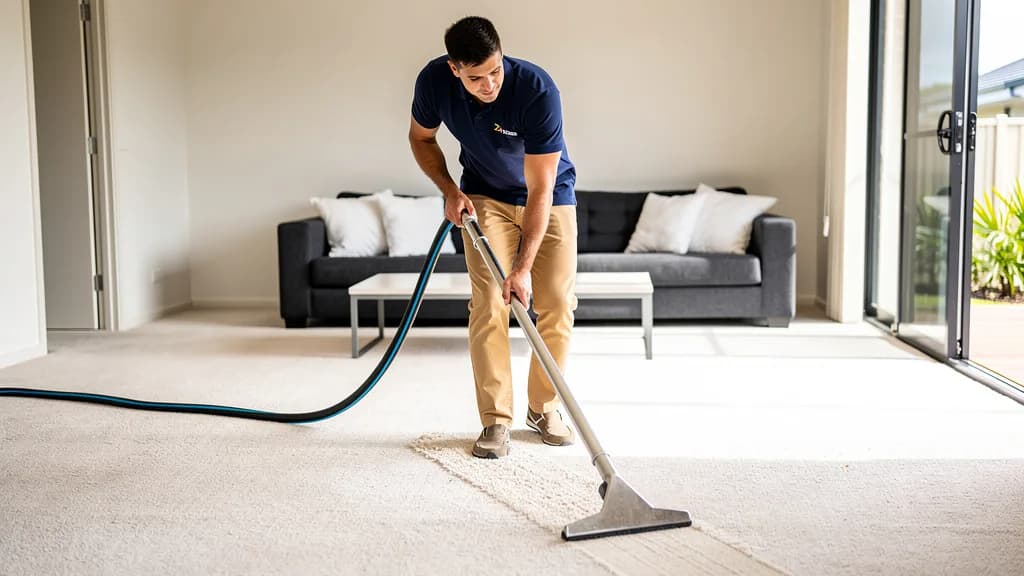
Standard upright or barrel vacuum cleaners generate suction that draws material from the surface of the pile. Baking soda (particularly after multiple applications) settles to the base of the pile and compacts around the fibre roots. The suction created by most domestic vacuums is insufficient to draw this compacted powder back up through the full pile depth. Some of the powder is removed with each vacuum pass, but a meaningful fraction remains. Professional truck-mounted extraction equipment generates significantly higher suction (typically 10–15x domestic vacuum airflow) and can reach material at the pile base.
How to Remove Baking Soda Residue
For mild accumulation (one or two applications, well-vacuumed): thorough vacuuming in multiple directions (four passes at 90-degree angles to each other) removes the majority of the residue. A rubber-bristle carpet rake or stiff brush used before vacuuming agitates the powder loose from the pile base before the vacuum pass.
For significant accumulation (repeated applications over months): professional hot water extraction is the most effective solution. The hot water dissolves the baking soda and the extraction removes it from the pile in solution. A single professional clean removes baking soda residue that years of domestic vacuuming could not fully clear.
Do not wet the baking soda first
Applying water or steam to carpet with significant baking soda residue before vacuuming it out will dissolve the powder into the fibres and make it harder to remove. Dry vacuuming first to remove as much powder as possible is essential before any wet cleaning method.
Better Alternatives to Baking Soda for Carpet Odours
For general carpet freshness, thorough vacuuming (removing the source of odour: dead skin cells, pet dander, food particles) is more effective than odour masking. For persistent pet odour, an enzyme-based cleaner applied to the specific source area addresses the biological cause rather than masking it. For a whole-room freshness treatment, professional carpet cleaning with a deodorising extraction additive removes both the odour source and any existing baking soda residue in one clean.
Find a local cleaner in the Sutherland Shire
In the Sutherland Shire? We know your time matters. Leave your enquiry with us and we'll make it our priority to get you a quote from a local cleaner.
Get a MatchThis site matches enquiries with independent local carpet cleaners. We do not employ cleaners directly.
Get a Shire quote
In the Sutherland Shire? We help you get a quote from a local cleaner. They quote you directly.
Frequently asked
I left baking soda on the carpet overnight. Is that a problem?
A single overnight application that is thoroughly vacuumed the next day causes minimal lasting residue. The issue arises with repeated applications or extended dwell times (several days) that allow the powder to compact into the pile. One-off uses with prompt, thorough vacuuming are low-risk.
The carpet feels gritty after baking soda treatment. What does that mean?
A gritty texture underfoot is the tactile sign of baking soda residue compacted in the pile. Multiple vacuum passes in different directions with a stiff-bristle attachment can improve this, but significant gritty residue typically requires professional extraction to clear fully.
Can I use a carpet cleaning rental machine to remove the baking soda residue?
A rental machine with hot water extraction will remove a significant portion of the residue, but rental machines have less suction power than truck-mounted professional equipment and may leave some powder at the pile base. They are a reasonable DIY option for mild accumulation. For heavy accumulation, a professional clean gives a more thorough result.
My carpet has a white powdery look after baking soda treatment. Will a clean fix this?
Yes, the white cast is dissolved baking soda residue coating the carpet fibres. Professional hot water extraction dissolves and removes this coating, restoring the carpet's original colour and texture. If the white cast persists after a professional clean, it may indicate product residue from another source (e.g., carpet shampoo) rather than baking soda.