
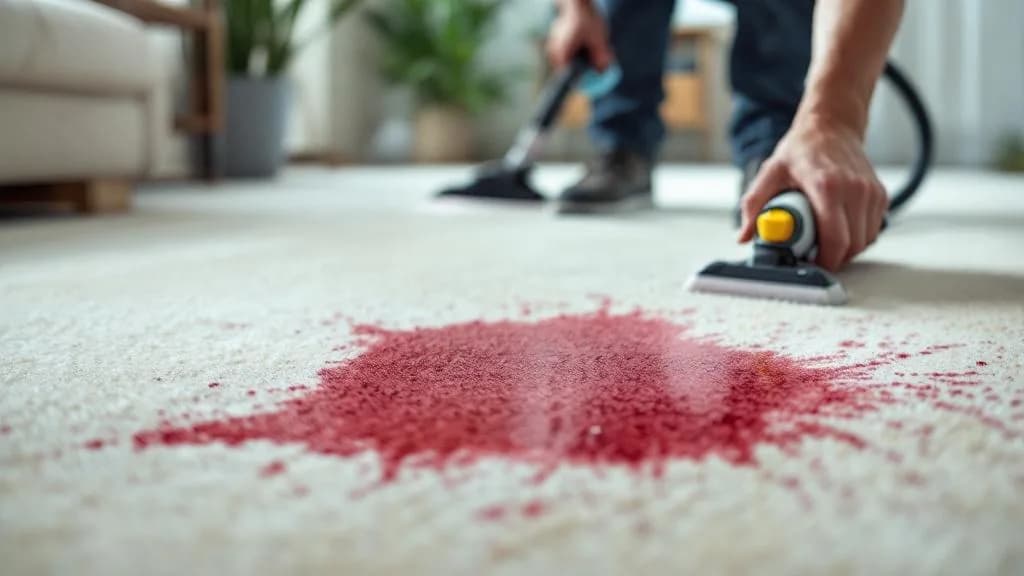
Act in the first 5 minutes (fresh stain)
Speed is everything with red wine. The anthocyanin pigments in wine begin bonding to carpet fibres within minutes of contact. Here's what to do immediately:
- 1.Grab a white absorbent cloth or a stack of paper towels. Avoid coloured cloths: the dye can transfer to wet carpet.
- 2.Blot from the outside inward. Never rub. Rubbing pushes the wine sideways and works it deeper into the carpet pile, causing mechanical fibre damage that makes stains far harder to remove later.
- 3.Pour a small amount of cold water directly onto the stain. Not hot: hot water can set certain carpet treatments and force pigment deeper into the fibre.
- 4.Blot again firmly. Repeat the cold water and blot cycle until no more colour transfers to the cloth. On light synthetic carpet, this alone can clear a fresh spill.
Dish soap and white vinegar mix (stain still fresh)
If blotting with cold water alone isn't shifting it, move to this household mix while the stain is still fresh:
The mix
1 teaspoon dish soap + 1 teaspoon white vinegar + 1 cup cold water
- 1.Apply a small amount to the stain, working from the edges inward. Don't pour: a controlled application avoids spreading the stain.
- 2.Let it dwell for 5 minutes, then blot with a clean white cloth. Repeat until the stain lifts.
- 3.Rinse with plain cold water to remove soap residue. Soap left in carpet fibres attracts dirt over time.
Use white vinegar only. Red, balsamic, or apple cider vinegar all carry their own tannins and dyes. They add to the problem rather than solving it.
Set stain (24 hours or older)
Once red wine dries, the chromogen dye molecules bond more tightly to the carpet fibre. Your options narrow: but it is not always hopeless.
Hydrogen peroxide (light or white carpet only)
Mix 1 tablespoon of 3% hydrogen peroxide (pharmacy variety) with 1 teaspoon of dish soap. Patch test on a hidden section of carpet first: peroxide can bleach carpet dye. Apply, dwell 5–10 minutes, then blot clean.
Do not use on wool or natural-fibre carpets. Peroxide degrades wool and can permanently alter its dye.
Carbonated water
Pour a small amount of cold sparkling water over the stain and let it dwell for a few minutes. The carbonation can help lift residual dye that plain cold water will not shift. Blot dry after each application.
Know when to stop. Wool and natural-fibre carpets absorb dye quickly. A 24-hour stain on wool may already be permanent without professional treatment. If you have tried cleaning and the stain appears to be spreading, further DIY agitation typically makes things worse.
When to stop DIY and find a local cleaner
Some situations call for equipment and chemistry that aren't available in a grocery-store bottle. Stop DIY and find a local cleaner if:
- The stain is older than 48 hours on wool or a natural-fibre carpet.
- You have tried the dish-soap mix and the stain has spread rather than lifted.
- DIY treatment has lightened the surrounding area, making the stain more visible.
- The carpet pile is matting down or stiffening in the stained area.
If DIY doesn't lift it. Find a local cleaner.
A cleaner you're connected with can assess your carpet fibre type and apply colour-safe oxidising treatments at a commercial pressure and temperature that household products cannot reach.
We know your time matters. Leave your enquiry with us and we'll make it our priority to get you a quote from a local cleaner. How this works
Get a local quoteMyths: skip these
These home remedies are repeated constantly online, and all of them either do nothing useful or actively make the stain worse.
Salt
Salt does not neutralise wine dye. It can draw some surface liquid via osmosis, but it also drags the wine deeper through capillary action and the crystals cause abrasive fibre damage. Skip it entirely.
White wine over red wine
Pouring white wine over red neutralises some acidity temporarily, but does nothing to break down the dye. You are adding more liquid volume and wasting the blotting window that would actually help.
Boiling water
Hot water can set protein-based treatments in certain carpet fibres and pushes pigment deeper. Always use cold water.
Bleach
Bleach will strip the colour from any carpet that is not white. Do not use bleach on coloured carpet under any circumstances.
Does carpet fibre type change what you should do?
Yes, significantly. The same treatment that works on polyester can permanently damage wool.
Wool carpet
Wool is naturally colour-fast but stains set fast in the fibre. Use only cold water and a small amount of dish soap. Avoid alkaline cleaners (including baking soda pastes), peroxide, vinegar, and steam: all can damage wool fibres or alter the dye. If the stain does not respond quickly to cold-water blotting, stop and find a local cleaner before attempting any chemical treatment.
Synthetic carpet (nylon, polyester)
More forgiving of cleaning chemicals. Responds well to the dish-soap and white vinegar mix. On light-coloured synthetic carpet, hydrogen peroxide can be tried after a patch test. Allow adequate dwell time and blot thoroughly to remove residue.
Berber (loop-pile) carpet
Berber's tight loops trap wine deep and are slow to release moisture. Excessive wetting can also damage the latex backing. Use minimal liquid and avoid soaking. If the stain does not lift promptly from the surface, find a local cleaner before it penetrates further.
Frequently asked
Will salt remove a red wine stain from carpet?
No. Salt is a common home-remedy myth. Pouring salt on a fresh wine spill can draw some liquid out via osmosis, but it also drags the wine deeper into carpet fibres through capillary action and can cause abrasive fibre damage. Blot with a clean white cloth and cold water instead. It does the job without the damage.
How long do I have before a red wine stain sets?
The sooner the better, but in practical terms you typically have under 30 minutes before the wine begins to bond to carpet fibres. After 24 hours the chromogen dye molecules form stronger bonds with the fibre, especially on wool and natural-fibre carpets. On synthetic carpet there is more time (sometimes up to 48 hours) but acting early always gives better results.
Can a professional cleaner remove an old red wine stain?
Often, yes: especially if the stain is under 72 hours old or on synthetic fibre. A cleaner connected through us can apply colour-safe oxidising treatments and hot-water extraction at a commercial temperature and pressure that exceeds what household products can achieve. Results on older stains on wool vary widely, in many cases there is significant improvement, in others the stain may be permanent. Be upfront with the cleaner about the stain's age and carpet type so they can set realistic expectations before they start.
Is hydrogen peroxide safe on coloured carpet?
No, not on coloured carpet. Hydrogen peroxide (even the 3% pharmacy variety) can bleach carpet dye. Only use it on white or near-white carpet, and always do a patch test in a hidden area first. On any mid-tone or dark carpet, skip peroxide entirely and use the dish-soap and white vinegar solution instead.
Does white wine actually neutralise red wine?
No. White wine neutralises some of the acidity in red wine, which can make the stain temporarily easier to blot, but it does nothing to break down the dye. You're effectively adding more liquid volume and giving yourself less time to remove it. Save the white wine and focus on cold water and blotting.
What if the carpet is wool?
Be cautious. Wool is more susceptible to both chemical damage and rapid dye set than synthetic carpet. Use only cold water and a small amount of dish soap: no vinegar, no peroxide, no steam, no alkaline cleaners. Blot gently. If the stain doesn't respond quickly to cold-water blotting, stop and find a local cleaner rather than risk fibre damage trying stronger solutions at home.