
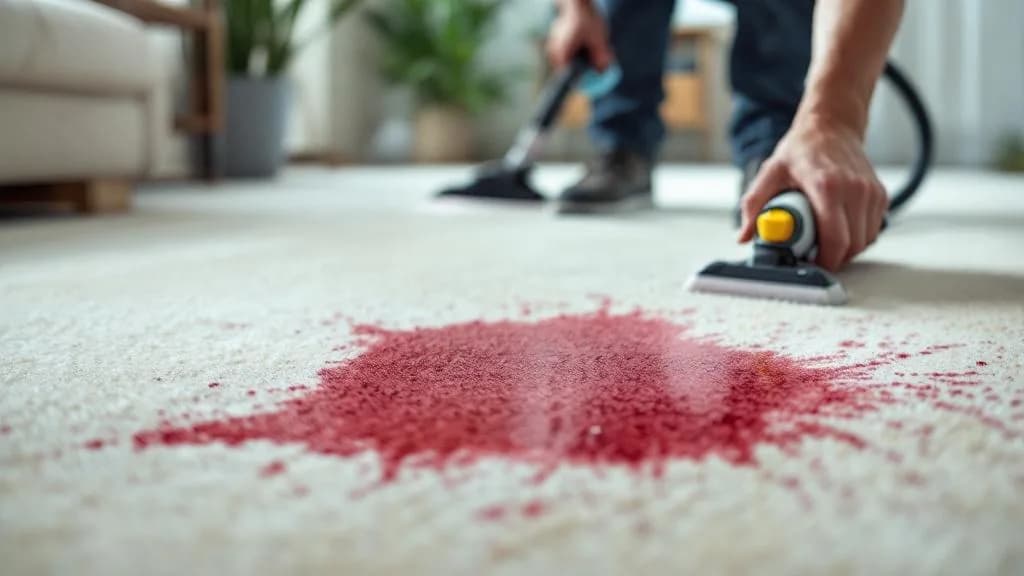
Why Surface Cleaning Keeps the Smell Coming Back
When a pet urinates on carpet, the liquid moves fast. It passes through the carpet pile, through the backing, and into the underlay, often reaching the subfloor beneath within minutes of a large accident. The carpet surface you can blot and treat is only the top layer of a much deeper problem.
Once the moisture dries, the urine doesn't disappear. It leaves behind uric-acid salts that crystallise into the carpet fibres and underlay. These crystals are stable when dry, which is why a cleaned carpet can seem fine for days or weeks. Then humidity arrives (from rain, a mop, a steam cleaner) and the crystals rehydrate and release the ammonia odour again.
This cycle can repeat for years. Masking products like sprays and powders work on the same layer-one problem: they cover what's on the surface while the crystal reservoir in the underlay remains untouched.
The Enzyme Approach: The Only DIY Method That Works
Enzyme cleaners contain biological agents that break down the uric-acid crystals rather than masking them. They are the only DIY product category that addresses the root cause of pet urine odour.
Choose the right product
Look for products labelled specifically as enzyme cleaners or bio-enzymatic cleaners for pet urine, not general stain removers or carpet shampoos. The enzymes need to be present and active; some multi-purpose cleaners include a small enzyme fraction that is insufficient for deep-set uric-acid deposits.
Saturate to underlay depth
Apply the enzyme cleaner generously: the product needs to reach wherever the urine went, which means saturating through the carpet pile and into the underlay. Light surface application will not contact the crystals sitting deeper in the material. For an average dog accident, you typically need considerably more product than feels instinctive.
Allow a full 24-hour dwell. Do not blot early
The enzymes need time to work through the material and complete the chemical breakdown. Blotting or vacuuming before the dwell period is up removes the active solution before it finishes the job. Cover the treated area with a damp cloth or plastic wrap to slow evaporation and keep the enzymes active longer.
Repeat on stubborn spots
One application often is not enough for older stains or areas that have been soiled multiple times. Repeat the process (saturate, dwell, allow to dry completely) until the odour is fully gone. Checking with a UV blacklight in a dark room helps locate the full extent of the staining so you treat the right area.
Common Myths That Don't Work
Vinegar + baking soda
Vinegar neutralises surface alkalinity and baking soda absorbs surface odour. Neither breaks down uric-acid crystals. The smell will return with the next bout of humidity. Skip both.
Bleach
Bleach destroys carpet dye and fibres and does not address the uric-acid crystals in the underlay. It also creates toxic fumes when mixed with ammonia compounds in urine. Do not use it on carpet.
Steam cleaning alone
Without enzyme pre-treatment, steam can temporarily mask odour while the heat drives moisture (and reactivated crystals) deeper into the underlay and subfloor. Always apply an enzyme treatment and allow it to fully dry before any steam cleaning.
Air fresheners and deodorisers
These mask surface odour for hours or days. The underlying crystals remain. As soon as the fragrance fades or humidity rises, the pet urine smell returns unchanged.
When DIY Can't Solve It
Some situations are beyond what enzyme cleaners can fix at home:
- Old or set-in stains where the carpet has discoloured
- Multiple accidents in the same area over months or years
- Smell returns immediately after thorough enzyme treatment
- Whole-room or whole-house odour (likely subfloor contamination)
If DIY doesn't fix it. Find a local cleaner who can treat to the carpet backing and assess subfloor risk.
We know your time matters. Leave your enquiry with us and we'll make it our priority to get you a quote from a local cleaner. How this works
Get a local quoteCat Urine vs Dog Urine: Does It Matter?
The treatment is the same enzyme approach for both, but understanding the difference helps you calibrate how many applications to expect.
Cat urine
More concentrated due to cats' highly efficient kidneys. The stronger smell and higher uric-acid density mean cat urine typically requires more applications of enzyme cleaner and a longer dwell time than dog urine. Old cat urine spots (especially from repeat-offence corners) are among the hardest DIY jobs.
Dog urine
Typically larger volume per accident than cat urine, which means deeper penetration into the underlay. A large dog accident in a tightly backed carpet can easily reach the subfloor. The enzyme approach still works, but volume of product applied matters more here than with cat accidents.
Carpet Fibre Tips
The enzyme approach works across all carpet types, but fibre characteristics affect how you apply it.
Wool
More absorbent than synthetics and prone to shrinkage when over-saturated. Use a wool-safe enzyme product (check the label) and apply carefully: saturate enough to reach the underlay without flooding the area. Allow to dry slowly away from direct heat.
Synthetic (nylon, polyester)
The most forgiving fibre for enzyme treatment. Synthetic carpets hold the enzyme solution well, are more resistant to oversaturation damage, and dry faster. Standard enzyme application guidance applies.
Berber (loop pile)
Berber's tight loops and dense backing trap urine deep and slow penetration of the enzyme cleaner. Multiple applications are often needed to reach the underlay. If you have a repeat-offence spot on Berber, getting matched with a local cleaner early saves a lot of effort: the compressed backing makes DIY treatment genuinely difficult.
Related guides
Frequently asked
Why does pet urine smell come back on humid days?
Urine that has soaked into the underlay leaves behind uric-acid crystals when it dries. Those crystals are stable until moisture reactivates them, which is exactly what happens on humid days, or after a light clean with water or steam. The smell returns because the crystals are still there. An enzyme cleaner that reaches the underlay depth is the only way to break them down permanently.
Will baking soda and vinegar remove pet urine smell from carpet?
No. Baking soda absorbs surface odour temporarily, and vinegar neutralises surface alkalinity, but neither product breaks down uric-acid crystals. The smell will return as soon as humidity reactivates the residue in the underlay. Enzyme cleaners are the only DIY option that chemically dissolves the uric-acid salts responsible for the persistent odour.
Can a professional cleaner remove old, set-in pet urine?
Often, yes: but it depends on how deep the contamination has gone. A cleaner matched for this job can apply enzyme treatment at higher concentration and volume than typical DIY applications, and assess whether the underlay or subfloor is also affected. If the subfloor has absorbed urine over time, the underlay may need to be lifted and replaced, which is beyond what any cleaning can fix.
Do enzyme cleaners work on cat urine?
Yes, enzyme cleaners are effective on cat urine, but cat urine is more concentrated than dog urine and typically requires more applications and a longer dwell time. A single treatment often is not enough for a fresh accident and rarely suffices for old or repeat-offence spots. Apply thoroughly, allow the full 24-hour dwell, and repeat until the smell is completely gone.
How do I find pet urine spots I cannot see?
A UV blacklight (ultraviolet torch) will cause dried urine to fluoresce in a darkened room. Hold it close to the carpet surface and scan slowly. Mark each spot before treating: urine often spreads wider than the visible stain suggests, so treat a larger area than you think necessary.
When does the underlay need to be replaced instead of cleaned?
If the carpet has been repeatedly soiled in the same area over months or years, urine will have saturated the underlay and potentially the subfloor beneath it. At that point, no cleaning method (DIY or professional) can eliminate the smell without removing the underlay. Signs that replacement is needed include: the smell returning immediately after enzyme treatment, visible yellow staining on the underlay when the carpet is peeled back, or a strong ammonia smell even after the carpet surface looks clean.
Still can't shift the smell?
If you've applied enzyme cleaner thoroughly and the odour keeps returning, the contamination has likely gone beyond the carpet. A local cleaner can assess whether the underlay or subfloor is involved, and what it will take to fix it.
We know your time matters. Leave your enquiry with us and we'll make it our priority to get you a quote from a local cleaner. How this works | How matching works
Get a local quote