
What Is Berber Carpet and Why It Needs Different Care
Berber is a loop-pile carpet construction: the fibre loops are left intact rather than cut. This gives the carpet its characteristic nubby texture, durability against wear, and resistance to pile crushing. In Australia, "Berber" is used loosely to refer to both traditional knotted-loop Berber (originally a North African weaving style, now replicated in nylon, olefin, and wool) and modern level-loop and multi-level-loop carpets. All share the same fundamental vulnerability: snagging.
A rotating beater brush (the standard cleaning head in most upright vacuum cleaners and carpet cleaning machines) works by agitating cut-pile carpet fibres to loosen embedded soil. On loop-pile carpet, the rotating brush catches the uncut loops and can pull a loop out of the backing: creating a snag. If the loop is attached to neighbouring loops (as it is in many Berber constructions), pulling the snag can unravel a run across the carpet similar to a run in a stocking.
Never use a rotating beater brush on Berber or loop-pile carpet
The most common cause of severe Berber damage is using an upright vacuum with a spinning brush bar, or a carpet cleaning wand with a rotating scrub head. Use suction-only tools for vacuuming and stain treatment. Even a single snag can cause permanent loop unravelling.
Vacuuming Berber Correctly
- Use a vacuum with suction-only operation: no rotating brush bar. Many canister vacuums and central vacuum systems are suitable.
- If using an upright vacuum, check whether it has a brush bar height adjustment: raising the brush bar fully so it does not contact the carpet is acceptable on some models.
- Some uprights have a brush bar on/off switch. Use it. If your vacuum does not allow the brush to be disabled and it is the only vacuum you have, use the floor-surface setting (hard floor mode) which disengages or raises the brush.
- Vacuum slowly and with straight passes. Do not use the aggressive back-and-forth motion that loosens embedded soil in cut-pile carpet.
Stain Treatment on Berber
The standard blot-not-rub approach is especially critical on Berber. Rubbing a stain on loop-pile carpet risks catching the loops and pulling them out as well as spreading the stain. Apply cleaning solution and blot only. Never scrub.
- Blot up the spill immediately with a clean cloth: press and lift rather than rubbing.
- Apply cold water to dilute, blot again.
- Apply cleaning solution (dish soap and cold water, or enzyme cleaner for protein/urine stains) to a clean cloth and press gently onto the stain. Do not rub.
- Allow the solution to dwell for the appropriate time, then blot up with a clean cloth.
- Rinse by pressing a damp cloth onto the area and lifting. Do not rub.
- Allow to dry with good air circulation.
Professional Cleaning for Berber
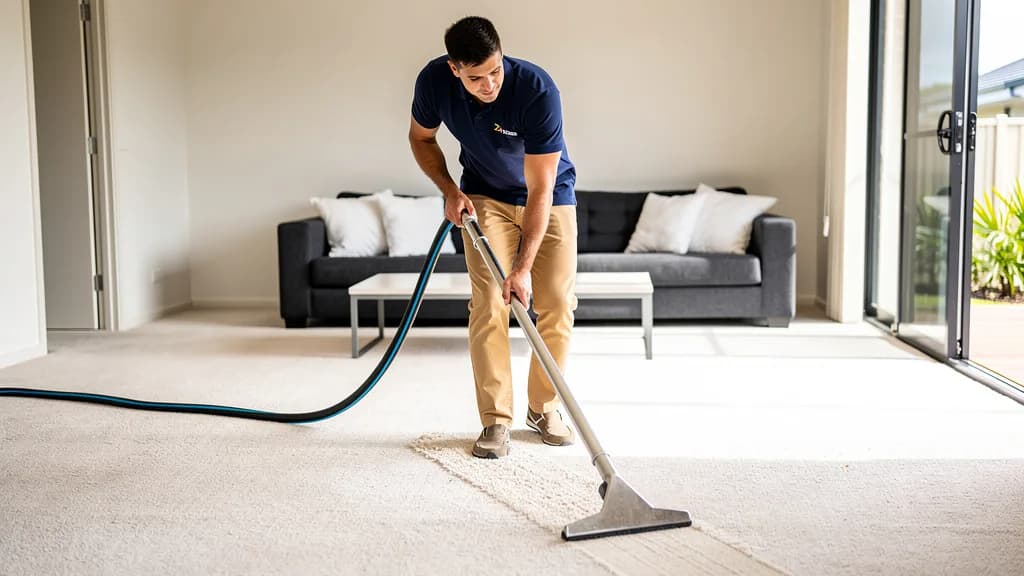
Hot water extraction (professional steam cleaning) is suitable for Berber carpet when performed with a standard extraction wand rather than a rotary cleaning head. When arranging professional cleaning for Berber or loop-pile carpet, specify the carpet type explicitly. This ensures the operator uses the correct wand and does not apply a rotary scrubbing attachment.
Bonnet cleaning and rotary shampooing are not suitable for Berber, both use a rotating pad that contacts the carpet surface and risks loop engagement. Hot water extraction and dry compound cleaning (which uses a granular compound worked in gently and vacuumed out) are the two recommended professional methods for loop-pile carpet.
Repairing Snags and Runs
If a loop has been pulled out and is sitting proud of the carpet surface (a snag), do not pull it further or cut it flush. This leaves a bald spot. The correct approach is to use a carpet needle to push the loop back down through the backing to its correct height. For a run (a series of pulled loops trailing across the carpet), a professional carpet repairer can re-anchor the loops using a carpet stretcher and adhesive. Early intervention prevents a small snag from becoming a long run.
Find a local cleaner in the Sutherland Shire
In the Sutherland Shire? We know your time matters. Leave your enquiry with us and we'll make it our priority to get you a quote from a local cleaner.
Get a local quoteThis site matches enquiries with independent local carpet cleaners. We do not employ cleaners directly.
Get a Shire quote
In the Sutherland Shire? We help you get a quote from a local cleaner. They quote you directly.
Frequently asked
Can I use a regular vacuum on Berber carpet?
Only if you can disable or raise the rotating brush bar. A standard upright vacuum with an active beater brush is the most common cause of Berber damage: the rotating brush catches loops and can pull them out, causing runs. Use a suction-only canister vacuum, or switch your upright to hard floor mode to disable the brush.
How do I get stains out of Berber carpet without damaging it?
Blot only: never rub. Apply cleaning solution to a cloth and press onto the stain; do not scrub across the pile. Berber loops can be pulled out by lateral friction, so all cleaning motion should be pressing and lifting straight up rather than side-to-side. Cold water and dish soap for most stains; enzyme cleaner for protein and urine stains.
A loop has pulled out of my Berber carpet: what do I do?
Do not cut it off and do not pull it further. A pulled loop can be pushed back through the backing using a blunt carpet needle. For a run of multiple pulled loops, a professional carpet repairer can re-anchor the loops. The sooner you act, the less the run extends.
Is Berber carpet suitable for homes with pets?
Berber is not the best choice for homes with dogs that scratch or cats that knead carpet: claws can easily catch and pull loops. If you have Berber and pets, keep cat and dog claws trimmed, place entry mats at doors pets use frequently, and inspect the carpet periodically for pulled loops to catch any runs early.