
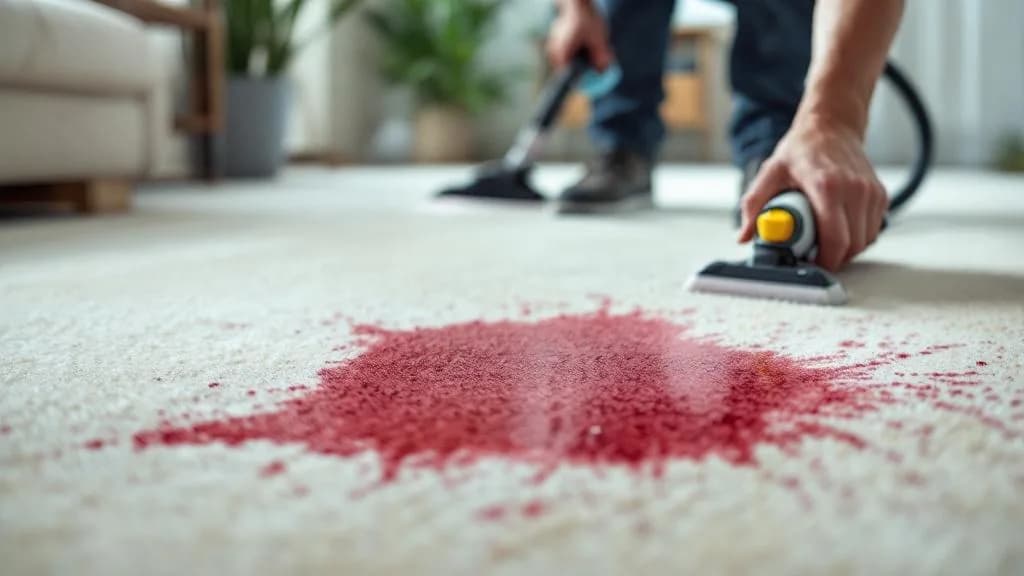
A flour spill on kitchen or dining room carpet is one of the more visually alarming baking accidents: the fine white powder covers a wide area instantly and has a way of getting everywhere. The key rule is the same as for other fine powders (baking soda, toner): vacuum before applying any liquid. Flour combined with water becomes a sticky paste that embeds in carpet fibres and dries to a stiff residue that is far harder to remove than the dry powder.
Step One: Dry Vacuuming
- Do not blot, wipe, or apply any liquid. Vacuum the spill immediately while the flour is still dry and loose.
- Use a vacuum with strong suction and work methodically from the outer edge of the spill inward to avoid spreading flour further.
- Multiple passes in different directions help lift flour that has settled into the pile. A crevice tool or upholstery attachment generates more concentrated suction for stubborn flour in the pile base.
- Continue vacuuming until no more white powder lifts from the carpet.
Never wet flour on carpet before vacuuming
Applying water, steam, or a damp cloth to a flour spill before vacuuming creates a paste that pushes deeper into the pile with each blotting action and dries hard. This is much more difficult to remove than dry flour. If someone has already applied water, allow the area to dry completely before attempting to vacuum or scrape out the dried residue.
Removing Residue After Vacuuming
After thorough vacuuming, a faint white powder residue or slight stiffness in the pile may remain. This is residual starch from the flour coating the fibre surface. A small amount of cold water on a clean cloth, blotted onto the area, dissolves the starch. Follow with a drop of dish soap, blot, then rinse by blotting with plain cold water. The area will likely feel slightly stiff until fully dry. This softens once the carpet dries completely.
Self-Raising Flour and Baking Powder
Self-raising flour contains baking powder (sodium bicarbonate and cream of tartar). A spill of self-raising flour leaves a similar powder residue to plain flour plus the alkaline baking soda component. The same vacuum-first approach applies, but if any moisture was present at the time of the spill (even humidity in a warm kitchen) the baking powder may have already begun to release carbon dioxide, leaving a slightly frothy or aerated residue in the pile. Allow this to dry fully before vacuuming. The dish soap and cold water rinse step addresses any alkaline baking soda residue remaining after vacuuming.
Cornflour and Cornstarch
Cornflour (cornstarch) is an even finer powder than plain flour and penetrates carpet pile more deeply. It is also more effective at forming a firm paste when wet. Vacuum thoroughly and consider using a stiff brush or carpet rake to agitate the fibres before a second vacuum pass to help dislodge deep-settled cornflour. The cold water and dish soap treatment works well for cornflour residue: cornstarch is pure starch and dissolves readily in cold water.
Find a local cleaner in the Sutherland Shire
In the Sutherland Shire? We know your time matters. Leave your enquiry with us and we'll make it our priority to get you a quote from a local cleaner.
Get a MatchThis site matches enquiries with independent local carpet cleaners. We do not employ cleaners directly.
Get a Shire quote
In the Sutherland Shire? We help you get a quote from a local cleaner. They quote you directly.
Frequently asked
I accidentally wiped the flour with a wet cloth before reading this. What do I do now?
Let the area dry completely. Do not apply more water or try to scrub. Once dry, the flour paste will have dried to a stiff crust. Use a blunt knife or spoon to carefully break up and lift the dried crust from the pile, then vacuum the fragments. Follow with cold water and dish soap blotting to remove remaining residue. Professional extraction may be needed for a large paste area.
The flour spill is in a high-traffic area and people have already walked through it. Will the flour have compacted?
Walking through a dry flour spill pushes the powder deeper into the pile. Vacuum with a stiff-bristle attachment to help agitate it free, then make multiple vacuum passes. If the flour was walked through when slightly damp, small compacted patches may have formed. Vacuum what you can, allow the area to dry, then treat dried residue patches with a damp cloth and dish soap.
Is there a stain risk from flour, or is it just a powder removal issue?
On most carpets, flour itself does not stain: the challenge is powder removal and preventing the paste problem. However, if the flour was left damp for an extended period and mould developed, a grey or yellow tinge can result. Treat any such residue with cold water, dish soap, and allow the area to dry thoroughly, then re-assess.