
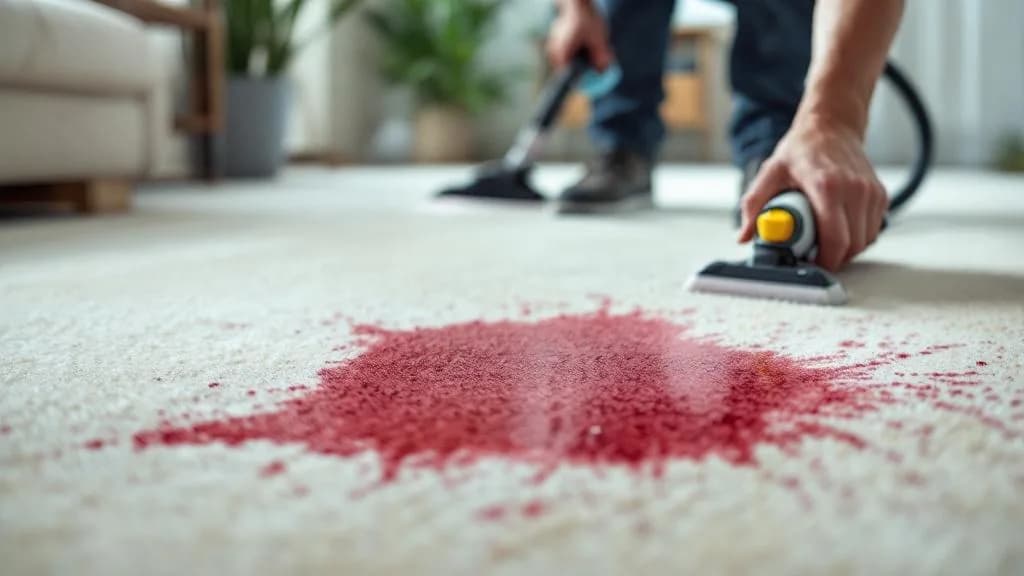
Hair bleach is a mixture of developer (hydrogen peroxide) and a bleaching powder containing persulphate activators. When it contacts carpet, the oxidising chemistry strips colour from the dye molecules in the carpet fibre within seconds to minutes. Unlike most stains, which deposit colour, hair bleach removes it. The visible result is a pale patch: orange, yellow, or white depending on the carpet colour and how much bleach contacted it and for how long.
What happens when hair bleach contacts carpet
The bleaching process begins immediately on contact. The rate of colour loss depends on the concentration of hydrogen peroxide (typically 3%–12% in box-dye developers), the dwell time, and the carpet fibre type. Nylon carpet is particularly susceptible to bleach colour loss. Polypropylene (solution-dyed) carpet is more resistant because the colour is locked inside the fibre rather than applied as surface dye. Wool is also susceptible: hydrogen peroxide damages wool fibre proteins at higher concentrations as well as removing colour. The priority on discovering a bleach drip is immediate neutralisation to stop further damage, not stain removal.
What you need
- Cold water (immediate flush)
- White cloths or paper towels
- White vinegar (neutraliser)
- Dishwashing liquid
- Baking soda
- Spray bottle
Immediate response steps
- Flush the area immediately with cold water: pour directly onto the bleach contact zone and blot up. Repeat three to four times. This dilutes the hydrogen peroxide and slows the bleaching reaction.
- Apply white vinegar directly to the flushed area. Vinegar is mildly acidic and helps neutralise the alkaline bleach mixture, stopping further chemical action.
- Blot the vinegar, then apply cold water again and blot dry.
- Apply a small amount of dishwashing liquid solution (one teaspoon to two cups cold water) and blot to remove any remaining bleach residue from the pile.
- Sprinkle baking soda over the area and leave for 30 minutes to absorb residue, then vacuum.
- Assess the colour damage once the carpet has dried: the true extent of colour loss is not visible until the pile is dry.
Colour loss cannot be reversed by cleaning
Flushing and neutralising the bleach stops further damage but does not restore colour that has already been removed. The pale or orange patch remaining after treatment is permanent colour loss, not a stain. The only options for restoring the appearance are carpet dyeing (professional spot re-dyeing to match the surrounding colour) or carpet patching (replacing the damaged section with a piece from a hidden area). Do not attempt to restore the colour with household products. This will not work.
Options after colour loss has occurred
Once hair bleach has caused colour loss in carpet, there are two practical restoration options. Professional carpet spot dyeing involves a technician mixing a dye to match the surrounding carpet colour and applying it to the bleached patch. This is the most common repair and can achieve a close but not always perfect match. Carpet patching involves cutting out the damaged section and replacing it with a piece taken from a hidden area such as inside a built-in wardrobe. The patch is bonded in place with carpet tape or adhesive. Both approaches require professional skills and are more cost-effective than replacing the entire carpet.
Find a local cleaner in the Sutherland Shire
In the Sutherland Shire? We know your time matters. Leave your enquiry with us and we'll make it our priority to get you a quote from a local cleaner.
Find a Matched Local SpecialistThis site matches enquiries with independent local carpet cleaners. We do not employ cleaners directly.
Get a Shire quote
In the Sutherland Shire? We help you get a quote from a local cleaner. They quote you directly.
Frequently asked
I got hair bleach on the carpet and flushed it immediately. Will there be any colour loss?
Very fast flushing within 30–60 seconds may limit the colour loss but is unlikely to prevent it entirely. The bleaching reaction begins on contact, even a brief exposure can cause some lightening depending on the peroxide concentration and carpet dye type. The best outcome of very fast flushing is minimal colour change rather than no colour change. Assess once dry and decide whether any colour change is visible enough to warrant repair.
The bleached patch is orange rather than white. Why?
Orange patches on carpet after bleach contact indicate partial colour removal. Most carpet dyes are blends of multiple dye components, and some components bleach out faster than others. On brown, beige, or darker carpet, the residual warm-toned dye components remain when the cooler tones bleach out first, leaving an orange or yellow result. This is the same chemistry that causes dark human hair to turn orange when bleached without a toner. The orange patch is a partially bleached zone: further bleach exposure would push it toward yellow and then white.
Can I use a carpet re-dye kit from a hardware store?
Consumer carpet dye kits are available but achieving a match to your existing carpet colour is very difficult without professional colour-mixing skills. Carpet dye must be matched to the original pile colour and applied with the correct technique and fixation process to give a lasting result. A poorly matched or unevenly applied DIY dye can make the repair more visible than the original bleach patch. Professional spot dyeing is recommended for results that blend well.
The bleach dripped near the centre of the room on a beige carpet. How large does a repair need to be?
A skilled carpet dyer can treat patches as small as a few centimetres across. The repair area is the bleached zone plus a small feathering margin to blend the dye into the surrounding carpet. For a small drip, the repaired area may be only 5–10 cm in diameter. Carpet patching is typically used for larger or irregularly shaped damage where spot dyeing would cover too large an area to match convincingly.