
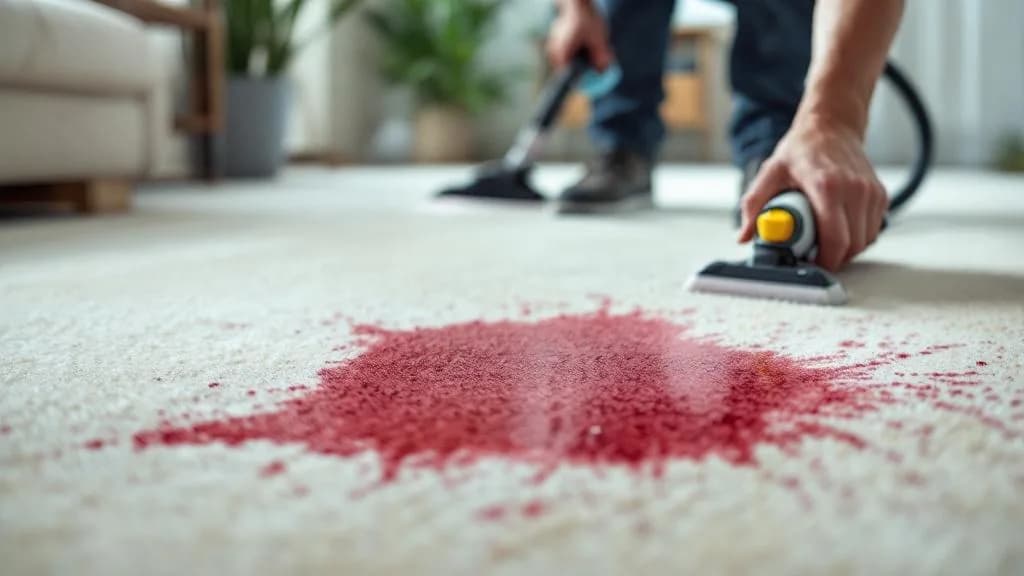
Most insect repellent creams and sprays contain DEET (N,N-Diethyl-meta-toluamide) as the active ingredient, typically at concentrations of 10–80%. DEET is an organic solvent. On synthetic carpet fibres (nylon, polyester, polypropylene) it can partially dissolve or permanently distort the fibre surface, leaving a matted, sticky, or discoloured patch. It can also strip carpet dye, particularly on polypropylene carpet. Speed of treatment is the single most important factor.
Act Immediately
Blot as much of the repellent as possible with a clean white cloth or paper towels. Press firmly and hold. Do not rub. Remove as much product as you can before applying any liquid, as diluting active DEET spreads it across a larger area of fibre.
Dish Soap and Cold Water
Apply a small amount of clear dish soap directly to the area and work in gently with your fingertips or a soft brush. Add a small amount of cold water and blot with a clean cloth. Repeat until no oily repellent residue transfers to the cloth. Dish soap breaks down the oil carrier in cream formulations and helps lift the DEET. Rinse with cold water and blot dry.
Isopropyl Alcohol for Stubborn Residue
If a greasy or tacky residue remains after dish soap treatment, apply a small amount of isopropyl alcohol (70%) to a white cloth and blot the area. Isopropyl alcohol dissolves DEET and the cream base more completely than water-based cleaners. Follow immediately with a cold water rinse and blot dry to remove the alcohol before it evaporates into the pile.
DEET Can Permanently Damage Synthetic Carpet
If the repellent has been on the carpet for more than a few minutes, the DEET may have already begun dissolving or distorting the fibre surface. Cleaning will remove the residue but cannot reverse fibre damage or dye loss. A matted, shiny, or discoloured patch after cleaning indicates fibre damage: professional re-dyeing or patch replacement may be the only remediation options.
DEET-Free Repellents
DEET-free repellents (picaridin, IR3535, oil of lemon eucalyptus) do not dissolve synthetic fibres in the same way. Picaridin and IR3535 are still oil-based and leave an oily residue. Treat with dish soap and cold water as above. These products carry no significant fibre-damage risk, but the oily carrier can still attract soil if not fully removed.
| Repellent Type | Fibre Risk | Treatment |
|---|---|---|
| DEET (any concentration) | High: dissolves synthetic fibres | Immediate blot, dish soap, isopropyl alcohol if needed |
| Picaridin / IR3535 | Low: oily residue only | Dish soap and cold water |
| Natural / plant-based | Very low | Dish soap and cold water |
Find a local cleaner in the Sutherland Shire
In the Sutherland Shire? We know your time matters. Leave your enquiry with us and we'll make it our priority to get you a quote from a local cleaner.
Find a Matched Local SpecialistThis site matches enquiries with independent local carpet cleaners. We do not employ cleaners directly.
Get a Shire quote
In the Sutherland Shire? We help you get a quote from a local cleaner. They quote you directly.
Frequently asked
Why is DEET so bad for carpet?
DEET is a plasticiser and organic solvent, not just a chemical irritant. At sufficient concentration and contact time, it partially dissolves or swells the surface of synthetic polymer fibres (nylon, polyester, polypropylene), causing permanent matting, softening, or colour loss. Wool carpet is more resistant to solvent damage but DEET can still strip dye from wool.
The repellent has left a shiny, matted patch: can it be fixed?
A shiny or matted patch after DEET contact is fibre damage, not a stain. The polymer surface of the fibre has been partially dissolved and the texture altered. Cleaning removes the DEET residue but cannot restore the fibre structure. Options include professional carpet re-dyeing (which can match the colour but not the texture) or plug-patch replacement for the affected area.
Can I use nail polish remover (acetone) to remove insect repellent from carpet?
Acetone is a stronger solvent than DEET itself and will cause more severe fibre damage on synthetic carpet. Do not use acetone. Dish soap with cold water, followed by isopropyl alcohol if needed, is the correct approach, both are less aggressive than acetone and effective at removing the DEET and cream carrier.
I got insect repellent spray (not cream) on my carpet: is the treatment the same?
Yes. Spray-format repellents contain the same DEET concentration as creams, but a solvent or alcohol carrier instead of a cream base. The DEET risk to carpet fibres is identical. Treat immediately with blotting, then dish soap and cold water. The alcohol carrier in spray formats evaporates faster than cream, which may slightly reduce contact time, but prompt treatment is still critical.