
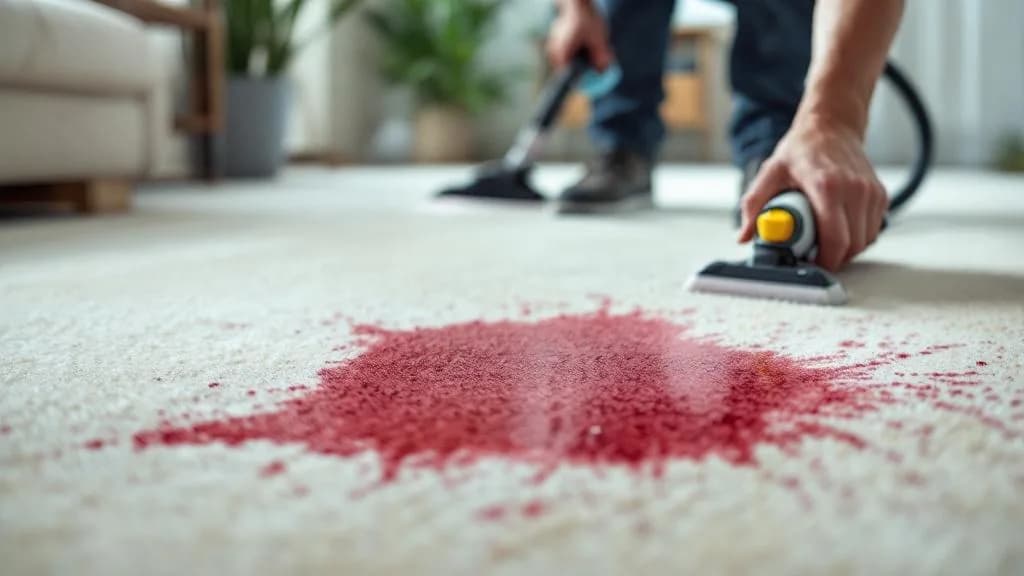
Lolly and candy stains in Sutherland Shire homes (particularly homes with young children) are among the most common carpet stains. A hard lolly stepped on, a bag of gummy bears tipped over, or a toffee dropped and ground into the pile all present the same core challenge: sticky sugar residue with intense food dye that can be very visible on light-coloured carpet.
Step One: Remove the Physical Candy First
Before applying any liquid, remove as much of the physical candy as possible. How you do this depends on the state of the candy when you find it.
- Hard candy that has not dissolved: use a blunt knife or spoon to carefully lever the piece free from the pile. Do not pull the fibres. Work around the edges. If the candy is bonded firmly, place a small zip-lock bag of ice over it for one to two minutes to harden and contract it, then lever free.
- Soft, sticky, or partially melted candy (gummies, toffee): chill with ice first to harden, then scrape. Warm or room-temperature gummies pull the fibres and spread the residue.
- Already crushed or crumbled candy: vacuum up the loose fragments before applying any liquid: wet sugar dissolves into the pile and is much harder to remove.
Removing the Sugar Residue
- Once the physical candy is removed, apply warm (not hot) water to a clean cloth and blot the sticky residue. Sugar is water-soluble: warm water dissolves it efficiently.
- Add a small amount of dish soap to the damp cloth and work into the residue, blotting from outside in.
- Continue blotting with clean damp cloth until no more stickiness transfers.
- Rinse by blotting with a cloth dampened in plain water to remove all soap residue: soap left in the pile attracts more dirt.
- Blot dry with a clean dry cloth and allow to air-dry.
Test for stickiness before declaring victory
Run your fingers across the treated area once it is fully dry. If it still feels tacky, there is residual sugar in the pile. Apply another round of warm water treatment. A sticky patch in a high-traffic area will attract grit and appear as a dark mark within days.
Removing the Food Dye Component
Many lollies and gummies contain concentrated synthetic food dyes, particularly red (Red 40), blue (Blue 1), and green, that can leave a vivid stain even after the sugar residue is gone. Once the sugar is removed, assess whether colour remains.
- For most synthetic food dyes on nylon or polyester carpet: a dilute solution of dish soap in cold water applied and blotted repeatedly removes the majority of colour.
- Persistent red or blue dye: a small amount of isopropyl alcohol on a cloth, blotted onto the stain, can lift stubborn azo food dyes. Follow with cold water rinse.
- Residual pink or blue tinge on light carpet: 3% hydrogen peroxide applied with a cloth, left for five minutes, then blotted and rinsed can reduce the tinge. Test in a hidden area first. Do not use on wool or dark carpet.
Sticky Lolly Trodden Deep into Pile
A lolly that has been walked over repeatedly and ground into the carpet base is one of the harder candy stain scenarios. The sugar and dye are distributed throughout the pile depth, and the fibres may have partially bonded to the candy residue. In this case, professional hot water extraction is the most effective approach: the high-temperature water dissolves deep-set sugar while the extraction removes it from the pile.
Gummy bears vs hard candy
Gummy bears and soft lollies contain gelatin or pectin in addition to sugar and dye. The gelatin component is protein-based and responds well to an enzyme cleaner (the type used for biological stains) in addition to the sugar removal steps above. If a gummy stain remains stubborn after dish soap treatment, an enzyme cleaner application and a 10-minute dwell time can help break down the gelatin residue.
Find a local cleaner in the Sutherland Shire
In the Sutherland Shire? We know your time matters. Leave your enquiry with us and we'll make it our priority to get you a quote from a local cleaner.
Get a MatchThis site matches enquiries with independent local carpet cleaners. We do not employ cleaners directly.
Get a Shire quote
In the Sutherland Shire? We help you get a quote from a local cleaner. They quote you directly.
Frequently asked
A lolly melted into the carpet in a hot car: how is that treated differently?
Melted candy in a hot environment has penetrated deep into the pile and possibly the underlay. Allow the carpet to cool first, then chill with an ice pack to harden the residue before scraping. Follow with warm water and dish soap treatment. Deep melted residue may require professional extraction, particularly if dye has wicked down to the underlay.
The candy stain has been there for a week. Can it still be removed?
Yes, sugar does not chemically bond to carpet fibres. Even a week-old hard candy stain can be re-moistened with warm water and treated with dish soap. The main risk from old candy stains is not the sugar itself but the fact that the tacky residue has trapped grit and dirt, which may leave a grey mark in the pile after the sugar is removed. Vacuum first, then treat.
Red lolly left a pink stain I cannot get out. What next?
Persistent red food dye (Red 40 / Allura Red) is one of the more stubborn azo dyes in candy. After dish soap treatment, try isopropyl alcohol blotted onto the stain. On light-coloured synthetic carpet, dilute 3% hydrogen peroxide can reduce the residual tinge. If the stain is on wool or polypropylene, avoid peroxide and contact a professional cleaner for targeted dye removal treatment.
How do I get chewing gum off carpet? Is it similar?
Chewing gum is different. It is a polymer base rather than sugar, so warm water does not dissolve it. The correct approach for gum is to harden it with ice first, then chip away the solid gum. Residual gum residue responds to dry-cleaning solvent or a small amount of peanut butter as a release agent (then follow with dish soap to remove the peanut butter).