
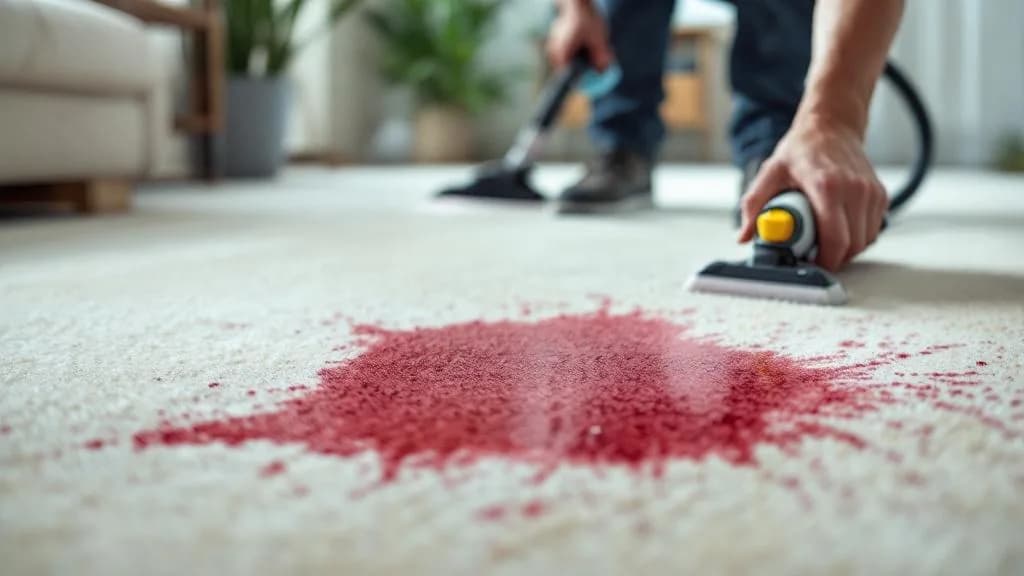
A jar of paprika, chilli powder, or cayenne tipped onto kitchen or dining carpet presents a two-part challenge: the fine dry powder must be removed first (like flour or baking soda), and then the red-orange pigment and trace essential oil left behind must be treated separately. The pigment in paprika is capsanthin, a carotenoid compound that is oil-soluble and can bond to synthetic fibres: treating it like a water-based stain alone will not fully remove it.
Step One: Remove the Dry Powder First
Do not wet the spice powder before vacuuming
Applying water to dry paprika or chilli powder on carpet dissolves the pigment and drives it into the pile immediately, making a concentrated coloured stain much larger and harder to remove. Always vacuum all loose powder before applying any liquid.
- Vacuum the spice powder immediately with strong suction, working from the edge of the spill inward.
- Make multiple passes in different directions: spice powder is fine and settles into the pile base.
- Continue until no more powder lifts from the carpet.
Treating the Pigment and Oil Residue
After vacuuming, a red-orange tint will likely remain. This is the carotenoid pigment from the spice combined with trace essential oils. Because paprika pigment is oil-soluble (not water-soluble), dish soap is the correct first treatment: dish soap is designed to emulsify and lift oil-based compounds.
- Apply a small amount of dish soap to a clean white cloth and blot the stained area. The surfactant in dish soap emulsifies the oil component and begins lifting the pigment.
- Work from outside the stain inward, blotting (not rubbing) to transfer colour to the cloth.
- Rinse by blotting with cold water. Repeat the dish soap and rinse cycle until no more colour transfers.
- For persistent orange-red residue on synthetic carpet: apply a small amount of isopropyl alcohol to a cloth and blot. Alcohol dissolves carotenoid pigments effectively. Follow with cold water rinse.
- Allow to dry and assess. In good light, a faint residual tinge is common on light carpet after a large spice spill.
Hydrogen Peroxide for Residual Tinge on Light Carpet
For a persistent yellow-orange tinge on light-coloured synthetic carpet (nylon or polyester) after dish soap and alcohol treatment, 3% hydrogen peroxide applied to a cloth, blotted onto the stain, and left for five minutes before rinsing can reduce the residual colour. Test in a hidden area first: hydrogen peroxide can affect some carpet dyes. Do not use on wool, polypropylene, or dark-coloured carpet.
Chilli Powder vs Paprika: Any Difference?
Chilli powder blends contain capsaicin (the heat compound) and typically some cumin, garlic powder, and other spices in addition to dried chilli. The staining mechanism is the same (carotenoid pigment and essential oils) and the treatment is identical. Cayenne pepper is almost pure dried capsicum and behaves identically to paprika for stain removal purposes. Smoked paprika has the same pigment plus a phenolic smoke compound that may respond slightly better to the isopropyl alcohol step.
Wash your hands before treating the stain
Chilli powder contains capsaicin that transfers easily from fingers to eyes and mucous membranes. Wear gloves when treating the stain, or wash your hands thoroughly before touching your face.
Find a local cleaner in the Sutherland Shire
In the Sutherland Shire? We know your time matters. Leave your enquiry with us and we'll make it our priority to get you a quote from a local cleaner.
Get a MatchThis site matches enquiries with independent local carpet cleaners. We do not employ cleaners directly.
Get a Shire quote
In the Sutherland Shire? We help you get a quote from a local cleaner. They quote you directly.
Frequently asked
I accidentally wiped the paprika with a wet cloth and now it is a big orange stain. What do I do?
Let the wetted area dry completely first: attempting to treat a spread wet stain usually makes it worse. Once dry, begin the dish soap and cold water treatment from the outer edge of the spread area. The stain area is larger now, but the treatment is the same. Follow with isopropyl alcohol if colour persists after the dish soap step.
The paprika stain has been there for a few days and is dried in. Can it be removed?
Dried paprika stain is harder than fresh but still responds to treatment. Start with the dish soap step: the surfactant penetrates the dried pigment. Follow with the isopropyl alcohol step. For a significantly set stain, a professional cleaner with an oxidising pre-spray can achieve better results than home treatment alone.
Paprika got on my cream wool rug. What is different about wool?
Treat wool with dish soap and cold water only. Avoid isopropyl alcohol and hydrogen peroxide on wool. The carotenoid pigment is the primary staining agent, and dish soap is still effective on wool. For any residual tinge on wool after home treatment, a professional wool-safe cleaner is the next step rather than escalating to harsher chemicals.