
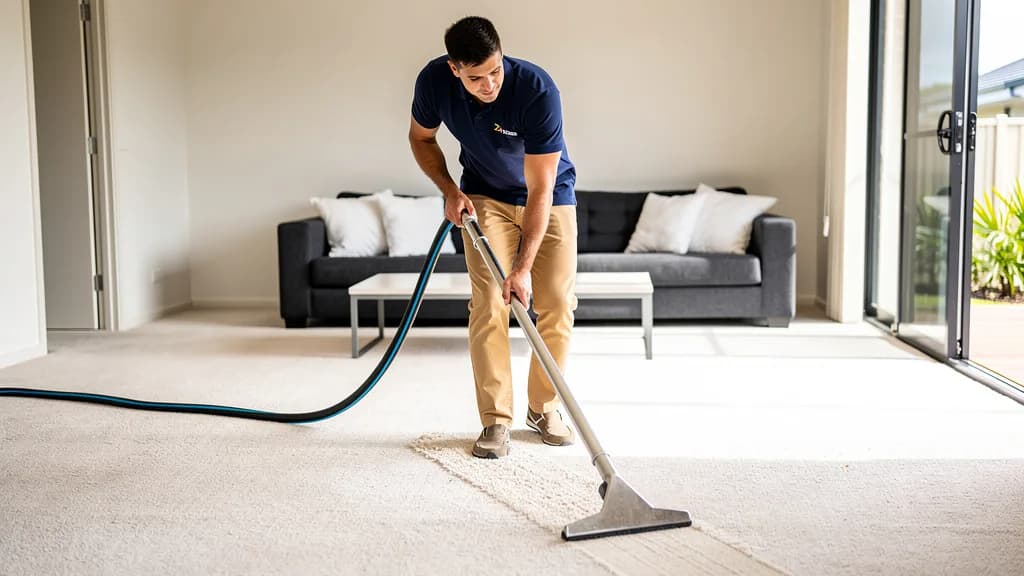
Bathroom renovations involve specific materials that kitchen renovations generally do not (waterproofing membranes, silicone sealants, and grout release compounds) in addition to the tile dust and adhesive common to both. The adjacent hallway or bedroom carpet typically bears the brunt of foot-tracked debris and overspray throughout the job.
Tile Dust and Grout
Ceramic and porcelain tile cutting generates fine silica-containing dust. Grout application generates cement residue. Both should be treated dry first:
- Allow all dust to settle and dry completely before vacuuming: wetting cement-based materials before removal embeds them as paste.
- Vacuum slowly with multiple overlapping passes using a plain suction head.
- For residual grout haze on carpet: white vinegar diluted in water (one to four ratio) applied on a cloth and blotted: the mild acid breaks down the alkaline cement components. Rinse with cold water.
- For set grout lumps on pile: chip off carefully with the flat of a butter knife or spoon, then treat the residue with warm water and dish soap.
Waterproofing Membrane
Liquid waterproofing membrane (used to coat the shower floor and wet areas before tiling) is a polymer-based product that dries to a rubberised film. If it drips or is tracked onto carpet:
- Fresh waterproofing: water-based formulations can be blotted and rinsed while still wet. Apply cold water and blot: the membrane can be diluted and lifted before it fully sets.
- Dried waterproofing film: peel off as much as possible once dried. Residual rubber-like material responds to eucalyptus oil or isopropyl alcohol. Apply to a cloth, blot the residue, follow with dish soap and water rinse.
- For larger areas of dried waterproofing on carpet: professional cleaning with a specialist solvent pre-treatment is more effective than DIY approaches.
Silicone Sealant
Silicone is used to seal around bath edges, shower screens, and wall junctions. Drips or smears of uncured silicone on carpet need to be dealt with before the silicone cures (typically two to four hours):
- Uncured silicone: scrape off the surface bead carefully with a plastic card. Apply isopropyl alcohol to a cloth and blot the residue: IPA partially dissolves uncured silicone.
- Cured silicone: chip off the surface lump with a flat tool held nearly parallel to the carpet. Residual silicone in the pile does not respond to solvents once cured. It must be mechanically removed. Very fine residual silicone may remain in the pile and is best left rather than risking fibre damage from aggressive treatment.
Find a local cleaner in the Sutherland Shire
In the Sutherland Shire? We know your time matters. Leave your enquiry with us and we'll make it our priority to get you a quote from a local cleaner.
Get a MatchThis site matches enquiries with independent local carpet cleaners. We do not employ cleaners directly.
Get a Shire quote
In the Sutherland Shire? We help you get a quote from a local cleaner. They quote you directly.
Frequently asked
There is a white cement haze on the carpet in the hallway from grouting the bathroom. It has dried hard. Can it be removed?
Dried cement grout haze on carpet pile can be reduced with multiple rounds of diluted white vinegar treatment and blotting. Apply the solution, allow three to five minutes dwell, scrub lightly with a soft brush, and blot. The acid dissolves the alkaline cement compounds progressively. Several treatment cycles are typically needed. Complete removal of heavy dried grout haze is not always achievable: professional cleaning with an alkaline pre-spray combined with mechanical agitation achieves the best results.
The tiler used a rubber mat to kneel on and it left black marks on the carpet in the doorway. What removes it?
Rubber mat contact marks on carpet are rubber pigment transfer: the same issue as rubber gym mats. Apply isopropyl alcohol or eucalyptus oil to a cloth and blot the black marks to dissolve the rubber pigment. Follow with dish soap and cold water, blot and rinse. For short-duration contact (a day's work), the marks typically respond well to this treatment. For a mat left in place for weeks, the transfer may be more persistent.