
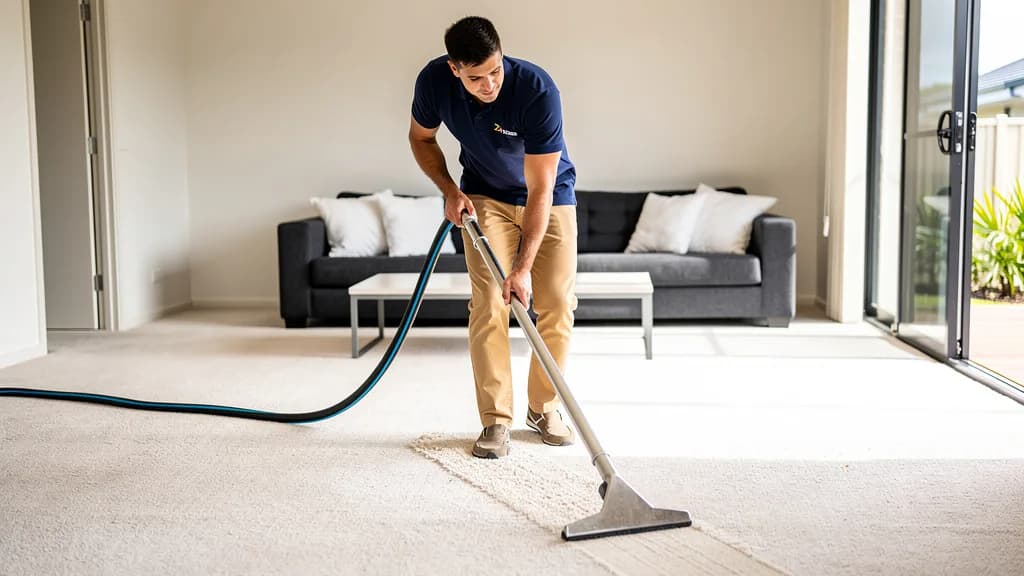
Plastering and skim coat work is common in Sutherland Shire homes during wall repair, ceiling restoration, and pre-painting preparation. The process generates two carpet hazards: fine plaster dust that becomes airborne and settles on carpet throughout the house, and wet plaster or compound splatter that lands on nearby carpet during application. Both require different handling: dust is a dry mechanical problem, wet splatter is a chemical one.
Plaster dust on carpet
Plaster and gypsum dust is alkaline and fine-particle. When it settles into carpet pile, vacuuming is the correct first response, but the technique matters. Pressing the vacuum head firmly into the pile and moving quickly can push particles deeper. Slow, overlapping passes with good suction draw the particles upward. A wet/dry vacuum with fine-particle filter outperforms a standard domestic vacuum for plaster dust recovery. Avoid damp mopping or wet wiping over plaster dust: water activates the gypsum and causes it to harden and bond to the fibres.
Wet plaster or compound splatter
Wet plaster splatter on carpet must be allowed to dry completely before removal: attempting to wipe wet plaster spreads it and works it deeper into the pile. Once dry, the hardened splatter can be gently broken away from the surface fibres using a plastic scraper, followed by vacuuming, followed by the white vinegar treatment to address the alkaline residue remaining in the pile.
What you need
- Vacuum cleaner (ideally wet/dry with fine-particle filter)
- Plastic scraper
- White vinegar
- Warm water
- White cloths
- Dishwashing liquid
- Spray bottle
Removing dried plaster splatter
- Allow wet splatter to dry completely. Do not attempt removal while wet.
- Once dry, gently break the hardened plaster from the carpet surface using a plastic scraper. Work in small sections; the goal is to break the deposit free from the pile rather than grind it in.
- Vacuum the broken fragments away with slow, overlapping passes.
- Apply white vinegar diluted 1:1 with water to the area: the acid neutralises the alkaline plaster residue remaining in the pile.
- Allow to sit for two to three minutes, then blot with a clean damp cloth.
- Follow with the dishwashing liquid solution to remove the vinegar residue, blot with warm water to rinse, and blot dry.
Protect adjacent rooms before work starts
Plaster dust travels further than expected through doorways and ventilation. Laying drop sheets in doorways and rolling carpet in the work zone before plastering begins prevents most contamination. If you are preparing an area for plastering, consider laying a polythene sheet over the carpet extending at least 1.5 m from the work wall: plaster board sanding and overhead skim work can deposit dust well beyond the immediate work area.
Find a local cleaner in the Sutherland Shire
In the Sutherland Shire? We know your time matters. Leave your enquiry with us and we'll make it our priority to get you a quote from a local cleaner.
Find a Matched Local SpecialistThis site matches enquiries with independent local carpet cleaners. We do not employ cleaners directly.
Get a Shire quote
In the Sutherland Shire? We help you get a quote from a local cleaner. They quote you directly.
Frequently asked
The plasterer sanded the skim coat and the dust has gone through the whole house. The carpet looks grey. Is this permanent?
A grey cast from plaster dust is not permanent: the dust is sitting in the pile rather than bonded to the fibres. Thorough vacuuming with multiple slow passes removes the bulk of the deposit. A wet/dry vacuum recovers more than a standard domestic unit. After vacuuming, a diluted white vinegar treatment neutralises the alkaline residue that causes a dull appearance. For very heavy coverage, a professional hot-water extraction clean after the initial vacuuming is the most complete solution.
The skim coat splatter dried on the carpet overnight. It is quite hard. Can I break it off without damaging the carpet?
Hardened skim coat splatter can be removed without pile damage if approached carefully. Use a plastic scraper rather than metal: metal edges cut fibres. Apply gentle lateral pressure at the base of the deposit to break it free from the pile surface rather than pressing down. Work in small sections, vacuuming away fragments as you go. The plaster deposit lifts in pieces rather than as a single unit in most cases. The carpet pile may be slightly stiff after removal: the white vinegar treatment softens the residual alkaline film and restores normal pile feel.
There is a ring stain around where a wet plaster bucket sat on the carpet. The centre is clean but the ring is a dark mark. What is this?
The dark ring from a plaster bucket is a migration mark: water from the plaster mix wicked outward through the carpet to the edge of the bucket base, carrying dissolved gypsum and pigment to the perimeter where it deposited as the water evaporated. Treat with white vinegar applied outward from the mark's edge inward to prevent the acidic solution from pushing the mark further. The alkaline gypsum dissolves in the acid and can be blotted away. Multiple passes are usually needed for a defined ring mark.
The carpet near the wall has a stiff, slightly shiny strip where the plasterer wiped tools. How do I soften it?
A stiff strip from tool wiping is dried plaster compound in the pile: the fibres are coated in the gypsum matrix and feel crunchy or stiff. Use the plastic scraper to break the deposit from the surface fibres first, then vacuum. Follow with a generous application of white vinegar solution to dissolve the remaining alkaline film: the vinegar application may need to sit for five minutes on a dense deposit. After blotting and rinsing, allow the carpet to dry and check whether the pile has returned to normal feel. A professional extraction clean removes stubborn residue more effectively than home treatment for heavy deposits.