
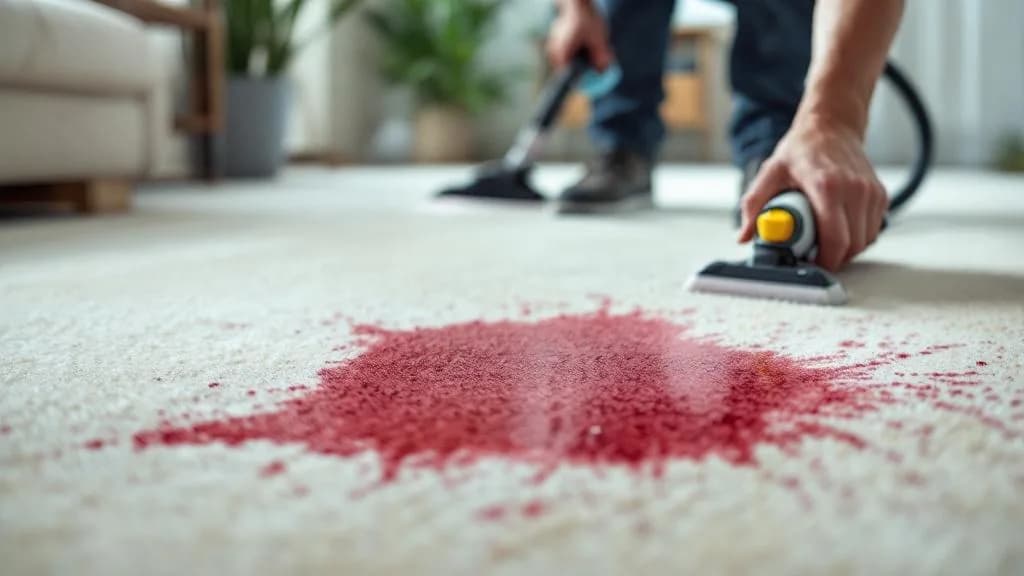
Sweet and sour sauce is made from vinegar, sugar or pineapple juice, ketchup or tomato paste, soy sauce, cornstarch as a thickener, and (in most restaurant and takeaway versions) red or orange food colouring. It may also contain pineapple chunks, capsicum, and onion. On carpet, the main challenges are: the vivid red-orange colour from tomato lycopene and food colouring; the high sugar content, which is hygroscopic and attracts re-soiling after cleaning if not fully removed; cornstarch residue that dries as a stiff film; acetic acid from the vinegar; and soy sauce protein. The colour concern is primary: sweet and sour sauce produces one of the most visible stains of any Chinese sauce on light carpet.
Cleaning steps
- Remove any pineapple chunks, capsicum, or onion pieces by hand.
- Blot immediately: sweet and sour sauce is liquid and spreads rapidly. Work from the outer edge of the spill inward to contain the colour spread.
- Apply cold water and blot to dilute the vinegar and begin dissolving the sugar. Do not let sweet and sour sauce dry on light carpet: the food colouring becomes significantly harder to remove once set.
- Apply dish soap solution (1 teaspoon per cup of cold water) and blot to emulsify the tomato paste and address the cornstarch film. Work the solution gently into the pile with your fingertips before blotting.
- Apply enzyme cleaner and allow 10–15 minutes for the soy sauce protein and tomato paste protein components.
- Rinse with cold water blotting: the sugar content means thorough rinsing is important. Multiple rinse passes help ensure the sugar is fully removed.
- Apply hydrogen peroxide (3%) for the tomato lycopene and food colouring pigment. Allow 10 minutes and blot. Food colouring in sweet and sour sauce (typically Red 40 or tartrazine Yellow 5) responds to hydrogen peroxide but may need two rounds. Allow the area to dry completely between rounds and assess in natural light.
- Apply baking soda lightly after the area is dry to address the vinegar smell if noticeable. Vacuum after a few hours.
Food colouring in sweet and sour sauce is more persistent than tomato pigment
Restaurant sweet and sour sauce almost always contains synthetic food colouring (Red 40, tartrazine, or sunset yellow) to achieve its characteristic vivid colour. Synthetic food dyes are designed to be colour-fast and resist washing, on carpet, they are more resistant to hydrogen peroxide than tomato lycopene. If the stain persists as an orange tinge after hydrogen peroxide treatment, switch to the alternating hydrogen peroxide and white vinegar approach (hydrogen peroxide for 10 minutes, vinegar for 5 minutes, hydrogen peroxide again) for tougher synthetic dye removal. Do not leave food colouring to dry: speed is the most important factor for synthetic dye removal.
Re-soiling after cleaning
Sweet and sour sauce carpet stains that appear fully removed but show visible dirt re-accumulation in the same spot within days have residual sugar left in the carpet. Sugar is hygroscopic: it absorbs atmospheric moisture and creates a slightly sticky surface that attracts dust and foot traffic soil. If re-soiling occurs after cleaning, re-wet the area with plain warm water, blot thoroughly to extract the residual sugar, and rinse again. A light dish soap solution applied in a second round (even after the area appears visually clean) followed by thorough rinsing removes residual sugar more completely than water alone.
Find a local cleaner in the Sutherland Shire
In the Sutherland Shire? We know your time matters. Leave your enquiry with us and we'll make it our priority to get you a quote from a local cleaner.
Find a Matched Local SpecialistThis site matches enquiries with independent local carpet cleaners. We do not employ cleaners directly.
Get a Shire quote
In the Sutherland Shire? We help you get a quote from a local cleaner. They quote you directly.
Frequently asked
The sweet and sour sauce had pineapple chunks in it. I read that pineapple contains a natural enzyme (bromelain). Does this help or hinder carpet cleaning?
Bromelain in fresh pineapple is a protease enzyme that breaks down protein, in theory, pineapple juice in sweet and sour sauce could assist with breaking down any soy sauce protein or meat protein present. In practice, the concentration of bromelain in a pineapple chunk spill on carpet is too low to produce a meaningful cleaning effect, and bromelain is denatured by heat during cooking (restaurant sweet and sour sauce is cooked). The pineapple primarily adds fructose (sugar) to the spill, which contributes to the re-soiling risk. Treat the pineapple component as sugar (thorough water rinsing is the key step) rather than relying on any enzymatic benefit.
The sweet and sour sauce dried on the carpet before I could clean it. There is now a stiff, glassy patch. How do I soften and remove dried sweet and sour sauce?
A stiff, glassy patch from dried sweet and sour sauce is primarily dried sugar and cornstarch, with food colouring pigment bound into the hardened film. To soften it: apply warm (not hot) water to the patch and allow 5 minutes for the sugar and starch to begin dissolving. Do not scrub: this breaks the hardened patch into fine fragments that embed deeper. Once slightly softened, use a spoon edge to gently lift the loosened film from the fibres, working from the outer edge inward. After mechanical removal, apply dish soap solution to treat the remaining dissolved residue, then enzyme cleaner, then hydrogen peroxide for the colour. A dried sweet and sour sauce stain will take more rounds than a fresh one. Expect two hydrogen peroxide applications for the food colouring.
The sweet and sour sauce was from a dark-coloured version (dark Chinese sweet and sour with heavy soy sauce and no red food colouring). Is the treatment different?
Dark sweet and sour sauce (Cantonese versions without tomato ketchup or food colouring, using more rice vinegar and soy sauce) presents a different staining profile from the bright red Westernised version. The colour is a dark amber-brown from soy sauce melanoidins (Maillard reaction compounds) rather than synthetic food dye or tomato lycopene. For dark sweet and sour: skip or de-prioritise the hydrogen peroxide step for colour, and instead focus on the enzyme cleaner step for the soy sauce protein, followed by a hydrogen peroxide round to address any residual amber melanoidin colour. The sugar and cornstarch components are the same: thorough water rinsing is equally important.