
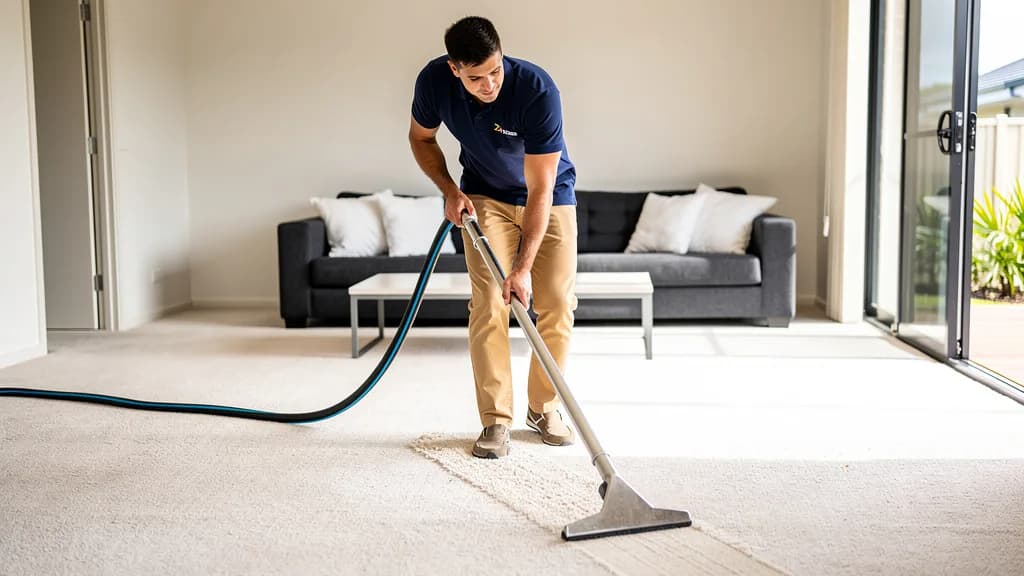
Water damage to carpet follows a predictable deterioration timeline. In the first 24 hours, carpet and underlay are wet but generally salvageable if extraction begins promptly. By 48 hours without treatment, mould spores are establishing in the underlay. By 72 hours, structural mould is present in most carpet types and the underlay is typically a write-off. The interventions available to you shrink rapidly with time.
Step 1: Stop the water source
Before any cleaning or extraction work begins, the source of the water must be stopped. This is obvious for a burst pipe (turn off the water main) but less obvious for roof leaks (tarping, redirecting) and stormwater entry (sandbags, redirecting gutters). Attempting to dry or extract while water is still entering is futile.
Safety before cleaning
Do not enter a room with standing water if electrical outlets, power boards or appliances may be in contact with the water. Turn off power at the circuit breaker for the affected area before entering. Water and live electricity are a life-threatening combination.
Step 2: Assess the water type
Not all water damage is equal. The water type determines whether the carpet is salvageable:
| Water type | Source examples | Salvageability | Action |
|---|---|---|---|
| Category 1 (clean water) | Burst supply pipe, rainwater, clean tap overflow | Usually salvageable if dried within 24–48 hours | Extract and dry immediately |
| Category 2 (grey water) | Washing machine overflow, dishwasher leak, aquarium spill | Often salvageable with professional extraction + antimicrobial treatment | Extract, treat with antimicrobial, dry |
| Category 3 (black water) | Sewage backup, floodwater from outside (rivers, stormwater) | Generally not salvageable: health risk too high | Remove and dispose of carpet and underlay; sanitise sub-floor |
Step 3: Extract standing water immediately
Remove as much standing water as possible before professional extraction equipment arrives. A wet-dry vacuum (shop vacuum) is effective for this: a domestic vacuum cleaner is not rated for water and will be damaged. Mop and bucket work for hard floors around the carpet perimeter. Do not use a standard vacuum cleaner on wet carpet.
Lift the carpet edges and check the underlay. In many cases the underlay (which sits directly on the sub-floor and has limited ability to dry) absorbs more water than the carpet itself. If the underlay is saturated through, replacement is often the most cost-effective outcome even if the carpet above it is salvageable.
Step 4: Ventilate aggressively
While waiting for professional help, maximise airflow across the wet area. Open all windows and doors, run ceiling fans, and direct floor fans across the carpet surface. Dehumidifiers significantly accelerate drying and are preferable to fans alone: borrow or rent one if available.
In Sutherland Shire's coastal suburbs, summer humidity can slow evaporative drying substantially. Air conditioning on the drying or dehumidify setting helps reduce ambient humidity and accelerates the process.
When is carpet salvageable vs needs replacement?
- Likely salvageable: Category 1 water (clean), less than 24 hours of saturation, carpet pile is intact, no pre-existing mould, underlay is only partially saturated.
- Borderline: Category 1–2 water, 24–48 hours of saturation. Extraction and professional drying may save the carpet but underlay replacement is likely needed.
- Not salvageable: Category 3 water (any duration), or any category with more than 48–72 hours of saturation without treatment. Signs of active mould (smell, visible growth) anywhere in the carpet or underlay.
- Wool carpet note: wool is more susceptible to irreversible damage from saturation than synthetic carpet. A wool carpet that has been wet for more than 12–18 hours should be assessed by a professional rather than assumed salvageable.
Professional water extraction and drying: what to expect
Water damage restoration is distinct from standard carpet cleaning. A professional water extraction job involves high-capacity truck-mount extraction to remove water from both carpet and underlay, placement of commercial-grade air movers (fans) and dehumidifiers (typically for 24–72 hours, depending on ventilation and weather) and moisture monitoring at the sub-floor level. The job is not complete when the carpet surface feels dry. It's complete when moisture readings at the backing and sub-floor reach acceptable levels.
For the Sutherland Shire, water damage restoration professionals with this equipment operate throughout the region. Describe your situation honestly when enquiring: the water type, source, and duration of saturation are the key information the professional needs to assess whether restoration or replacement is the right outcome.
Find a local cleaner in the Sutherland Shire
In the Sutherland Shire? We know your time matters. Leave your enquiry with us and we'll make it our priority to get you a quote from a local cleaner.
Find a local cleaner nowThis site matches enquiries with independent local carpet cleaners. We do not employ cleaners directly.
Get a Shire quote
In the Sutherland Shire? We help you get a quote from a local cleaner. They quote you directly.
Frequently asked
Can wet carpet be saved after a burst pipe?
Often yes, a burst supply pipe produces clean (Category 1) water, which gives carpet the best chance of salvage. The critical factor is time: extraction and drying begun within 24 hours of the event gives the best outcome. After 48 hours without treatment, mould is typically establishing and salvageability decreases significantly.
How long does it take for mould to grow in wet carpet?
Mould spores begin to establish in wet carpet and underlay within 24–48 hours of saturation in typical indoor conditions. Active mould growth is typically visible or detectable by smell within 48–72 hours. The underlay is usually the first area to show mould growth because it sits against the sub-floor with limited airflow.
Is carpet replacement always necessary after flooding?
Not always, it depends on the water type and the duration of saturation. Category 1 (clean) water with rapid extraction and drying can often save the carpet, though underlay replacement is frequently needed. Category 3 water (sewage, external floodwater) makes carpet non-salvageable in virtually all cases due to pathogen contamination.
Does home insurance cover water-damaged carpet in Sutherland Shire?
Most comprehensive home insurance policies cover sudden and accidental water damage (burst pipe, unexpected roof leak) including carpet replacement. They typically do not cover gradual water damage from a slow leak you failed to notice, or flooding from external floodwater in some policy definitions. Check your specific policy and notify your insurer promptly after the event.
Should I try to dry wet carpet with fans before the professional arrives?
Yes, aggressive ventilation slows mould development while you wait. Run ceiling fans and floor fans across the carpet surface, open all windows and doors, and use a dehumidifier if available. Do not use a standard household vacuum cleaner on wet carpet. Wet-dry shop vacuums are rated for water extraction and can remove standing water before professional equipment arrives.