
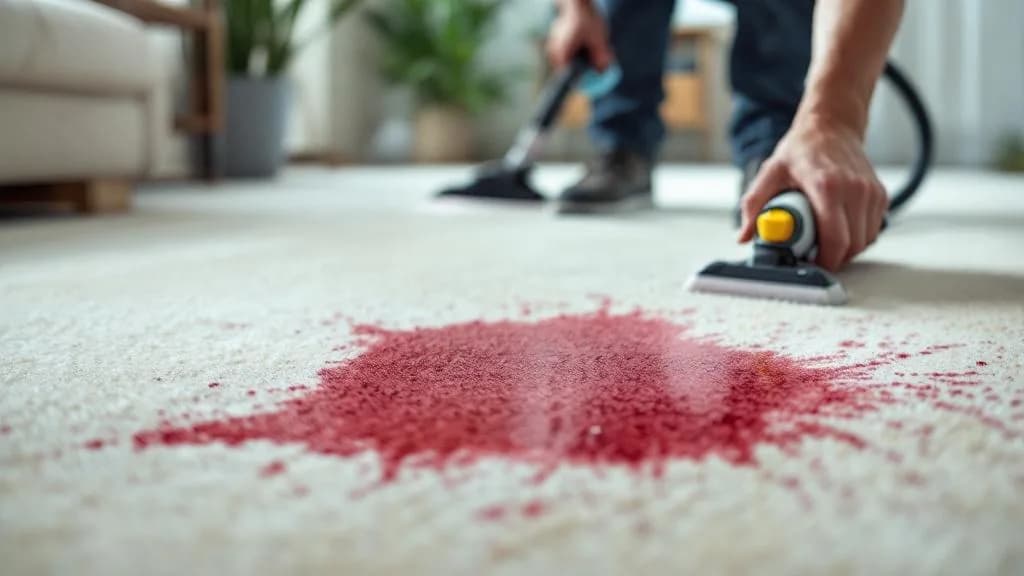
Cooking wine and vinegar are both common kitchen spills with distinct but related stain challenges. Cooking wine is essentially a lower-quality red or white wine with added salt. It contains tannins and colour pigments (in red cooking wine) that can stain carpet fibres, plus an acidic pH that can affect some carpet dyes. Vinegar (white, malt, or apple cider) does not leave a visible stain but has a sharp, persistent odour and an acidity that can affect delicate carpet dyes if left too long without rinsing.
Red cooking wine: treatment steps
- Blot up as much spilled wine as possible immediately with clean white cloths. Do not rub.
- Apply cold water to dilute the remaining wine and blot again. Repeat twice.
- Apply a small amount of clear dish soap and blot to lift the tannin pigment from the surface fibres.
- For remaining colour after dish soap: apply an enzyme cleaner or carpet stain remover containing enzymes. Allow it to dwell for 5 minutes, then blot with cold water.
- On light-coloured synthetic carpet, a careful 3% hydrogen peroxide blot can reduce persistent red-pink tint after degreasing. Test on a hidden area first.
- Rinse thoroughly and blot dry.
White cooking wine
White cooking wine contains little to no visible pigment but still carries tannins and acids. It will not leave a colour stain on most carpets if treated promptly. The primary risk is the acidity affecting carpet dye if left for an extended period. Cold water blotting followed by dish soap and a final cold rinse is sufficient for most white cooking wine spills. Check the dry result. If a faint yellow tinge is visible on light carpet, a hydrogen peroxide blot can address it.
Vinegar spill: removing the smell
Vinegar is acetic acid dissolved in water: the liquid itself evaporates, but the acetic acid can leave a smell that lingers in carpet fibres for days if not neutralised. The removal approach is: blot up the spilled vinegar immediately, then apply a solution of 1 teaspoon baking soda dissolved in 250ml of cold water to the affected area (baking soda is alkaline and neutralises acetic acid). Blot up the baking soda solution, then rinse with plain cold water and blot dry. The smell should resolve within a day of drying.
Vinegar is sometimes used as a carpet cleaner. It has limits
Diluted white vinegar is sometimes recommended for treating alkaline stains on carpet. It does work for this narrow purpose. However, it is not effective on oil, grease, protein, or dye stains, and strong or undiluted vinegar can affect carpet dye on sensitive fibres. Rinse any vinegar used for cleaning fully out of the carpet pile.
| Product | Stain type | Primary treatment | Odour step needed? |
|---|---|---|---|
| Red cooking wine | Tannin pigment + acids | Cold blot → dish soap → enzyme cleaner | No (odour minor once treated) |
| White cooking wine | Acids, minimal pigment | Cold blot → dish soap → cold rinse | No |
| White wine vinegar | Acidity, no pigment | Blot → baking soda solution → rinse | Yes, baking soda neutralise |
| Malt vinegar | Acidity + brown tint | Blot → cold rinse → baking soda | Yes, may need repeat |
| Apple cider vinegar | Acidity + light amber tint | Cold blot → dish soap → baking soda | Yes |
Salt on a cooking wine spill: does it work?
Applying salt to a fresh red wine spill is a traditional approach intended to absorb the liquid before it sets. It can help slightly in the first minute by drawing liquid to the surface, but it also adds sodium that needs to be rinsed out and does not replace a proper enzyme or surfactant treatment. Cold blotting is more effective and does not leave additional residue.
Find a local cleaner in the Sutherland Shire
In the Sutherland Shire? We know your time matters. Leave your enquiry with us and we'll make it our priority to get you a quote from a local cleaner.
Find a Matched Local SpecialistThis site matches enquiries with independent local carpet cleaners. We do not employ cleaners directly.
Get a Shire quote
In the Sutherland Shire? We help you get a quote from a local cleaner. They quote you directly.
Frequently asked
Is cooking wine harder to remove than regular red wine?
Cooking wine has added salt and a typically lower pigment concentration than table red wine, so it is not inherently harder to treat. The removal steps are the same. Salt in the wine means more rinsing is needed to clear mineral residue, but the tannin component responds identically to enzyme cleaner and cold water blotting.
The vinegar smell is still there after the carpet has dried: what do I do?
If the acetic acid smell persists after drying, the baking soda neutralisation step was either insufficient or missed. Re-apply the baking soda solution (1 teaspoon per 250ml cold water), allow to sit for 5 minutes, blot up, and rinse. Allow to dry again with ventilation. For a very large spill, professional hot water extraction removes the residual acid compounds more thoroughly than manual rinsing.
My carpet went lighter where I spilled vinegar: is this damage?
Yes, acidity can bleach or lighten carpet dye on sensitive fibres, particularly wool, some nylons, and naturally dyed carpets. This is a chemical dye change, not a surface stain, and it is not reversible by cleaning. Professional carpet re-dyeing is the only way to address acid-induced dye damage.
Can I use a carpet cleaning machine on a cooking wine spill?
Yes, once the visible bulk is blotted up and an enzyme pre-treatment has had time to work. Use the machine with plain cold water (or a carpet-safe enzyme solution) for the extraction pass. Cold water is important: the machine should not use its heating function on a fresh wine spill as heat can set tannin stains.