
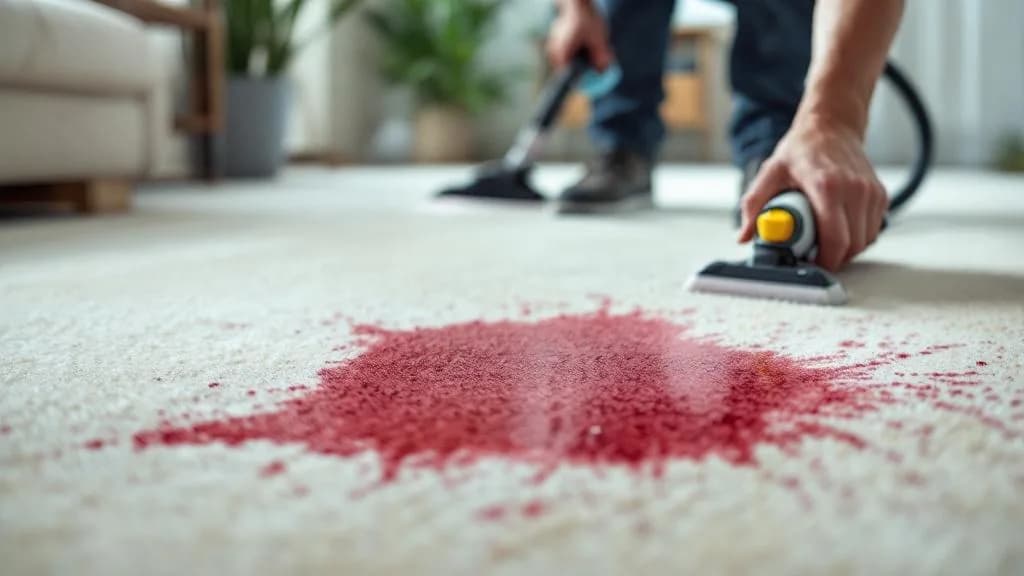
Dog anal gland secretion is a complex fluid containing oily fatty acids, proteins, and volatile amine compounds responsible for the characteristic fishy or musky odour. When expressed onto carpet (through scooting, involuntary expression during a fright, or deliberate marking) the secretion penetrates carpet fibres and, if not treated promptly, absorbs into the underlay. Standard carpet cleaners address the surface staining but typically do not fully break down the organic odour compounds. Enzyme cleaners are the most effective household product for this specific stain.
Immediate Steps
- Blot as much of the secretion as possible immediately with dry white cloths: press firmly and lift straight up from the outside edge inward.
- Use cold water only: hot water sets the protein component of the secretion into the carpet fibre.
- Do not rub the area, as this spreads the oil and odour compounds deeper into the pile.
Step One: Dish Soap for the Oily Component
- Apply a small amount of dish soap to the stain and work gently from the outside edge inward with a cloth.
- Add a small amount of cold water to create a light lather and continue blotting.
- Rinse with cold water on a clean cloth and blot dry.
- This step removes the oily fatty acid component of the secretion.
Step Two: Enzyme Cleaner for the Odour
Enzyme cleaners formulated for pet stains contain protease (breaks down protein), lipase (breaks down fats), and sometimes urease (breaks down urea). These enzymes act directly on the organic compounds in anal gland secretion, including the amine compounds responsible for the smell. Standard carpet deodorisers mask the odour; enzyme cleaners eliminate it at the molecular level.
- Apply enzyme cleaner generously to the affected area, ensuring it penetrates to the same depth as the original secretion.
- Allow to dwell for at least 15 minutes: longer dwell time (up to 30 minutes) improves results on stubborn odour.
- Blot gently with a clean cloth. Do not rinse immediately, as the enzymes continue working as the area dries.
- Allow to dry completely, then assess for remaining odour.
Step Three: Baking Soda for Residual Odour
Once the carpet is fully dry after the enzyme cleaner, apply baking soda liberally over the treated area and leave for at least three hours (overnight preferred). Baking soda absorbs remaining volatile odour compounds from both the carpet pile and the air around it. Vacuum thoroughly after the dwell period.
Repeated carpet scooting means full anal glands: a vet can help
If your dog repeatedly scoots on the carpet and you are treating anal gland stains regularly, this indicates the glands are not expressing naturally during defecation. A vet or groomer can manually express the anal glands to relieve the pressure and reduce carpet incidents. This is a much better long-term solution than repeated stain treatment.
Find a local cleaner in the Sutherland Shire
In the Sutherland Shire? We know your time matters. Leave your enquiry with us and we'll make it our priority to get you a quote from a local cleaner.
Find a Matched Local SpecialistThis site matches enquiries with independent local carpet cleaners. We do not employ cleaners directly.
Get a Shire quote
In the Sutherland Shire? We help you get a quote from a local cleaner. They quote you directly.
Frequently asked
The anal gland smell has come back on the carpet even though I cleaned it. Why?
Returning odour after apparent cleaning almost always indicates the secretion reached the underlay. The carpet surface may have been cleaned, but odour compounds in the underlay are re-volatilising upward through the carpet. Apply the enzyme cleaner more generously to ensure it penetrates to underlay depth: saturate the carpet so the enzyme solution reaches the underlay surface. Allow extended dwell time (30 minutes or more) and do not rinse. Let the enzymes work through the drying process. If odour persists after two enzyme treatments, the underlay is likely contaminated and professional extraction is the most effective next step.
Can I use bleach on the anal gland stain to kill the smell?
Avoid bleach on anal gland staining. Bleach masks some odour temporarily but does not break down the amine and fatty acid compounds causing the smell, in fact it can react with proteins to create additional volatile compounds. Bleach will also damage carpet colour. Enzyme cleaners are specifically formulated to break down the organic compounds that create the odour at the source; bleach is not.
My dog expressed anal glands on a cream wool carpet: will enzyme cleaner damage the wool?
Enzyme cleaners formulated for pet stains are generally safe on wool when used correctly. Apply at the concentration directed on the label, allow the specified dwell time, and do not leave the product saturating wool for extended periods. Rinse thoroughly after treatment. Test in a hidden area first if uncertain. The greater risk to wool from anal gland secretion is the oily fatty acid component that can bond to wool fibres if left untreated: prompt treatment with dish soap followed by enzyme cleaner is the right approach.