
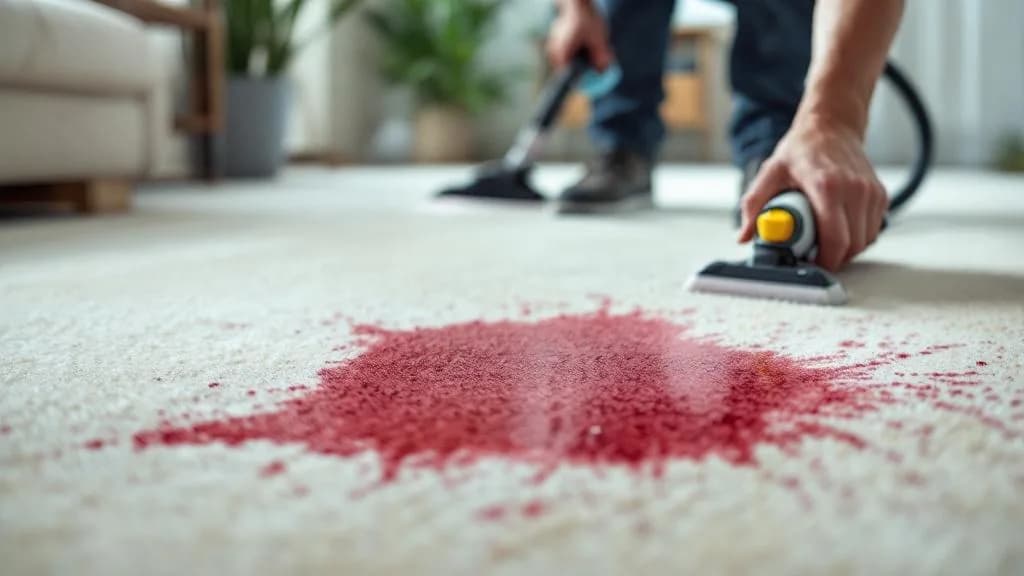
Fish sauce (used widely in Vietnamese, Thai, and other Southeast Asian cooking) is a fermented fish liquid with an intense colour and an extremely penetrating odour. It is one of the most difficult carpet stains to fully resolve because the odour compounds (primarily trimethylamine and short-chain fatty acids from the fermentation process) are highly volatile and bind to carpet fibres. The stain itself is a dark brown tannin that responds to standard treatment; the odour requires enzyme treatment to fully eliminate.
What you need
- White cloths
- Dishwashing liquid
- White vinegar
- Cold water
- Enzyme cleaner (essential: not optional for fish sauce)
- Baking soda
- Spray bottle
Treating the fish sauce stain
- Blot up as much liquid as possible immediately. Do not rub. Use clean cloths and press firmly.
- Apply cold water (not hot: heat sets protein stains) and blot to dilute the concentration in the pile.
- Apply dishwashing liquid solution and blot from the outside of the stain inward.
- Apply white vinegar to a cloth and blot: the acid in the vinegar helps neutralise the alkaline fish protein compounds and addresses the tannin pigment.
- Rinse with cold water and blot dry.
Eliminating the fish sauce odour
- After the stain treatment dries, apply enzyme cleaner to the affected area. Enzyme cleaners contain bacterial or fungal enzymes that break down the protein and organic acid compounds responsible for fish odour.
- Allow the enzyme cleaner to dwell for the time specified on the product (typically 15–30 minutes for carpet application).
- Blot away excess enzyme cleaner and allow to dry completely.
- Once dry, apply baking soda liberally over the area, leave for 30 minutes to absorb remaining volatile odour compounds, then vacuum.
- Ventilate the room thoroughly during and after treatment.
Do not use hot water on fish sauce
Hot water coagulates the fish proteins in the sauce, bonding them more strongly to the carpet fibre. Always use cold or lukewarm water for fish sauce and other protein stains (blood, meat juices, dairy). The dishwashing liquid and vinegar treatment works at cold temperature: no heat is needed or helpful for this stain type.
Find a local cleaner in the Sutherland Shire
In the Sutherland Shire? We know your time matters. Leave your enquiry with us and we'll make it our priority to get you a quote from a local cleaner.
Find a Matched Local SpecialistThis site matches enquiries with independent local carpet cleaners. We do not employ cleaners directly.
Get a Shire quote
In the Sutherland Shire? We help you get a quote from a local cleaner. They quote you directly.
Frequently asked
A bottle of fish sauce broke and spilled about 200 ml on the carpet. The smell is overwhelming. I cleaned the visible stain but the smell remains after two days. What do I do?
A 200 ml fish sauce spill has saturated the pile and likely the underlay beneath it. The odour persists after two days because the fermented protein compounds have penetrated to the underlay where surface enzyme cleaner application cannot reach them effectively. Apply enzyme cleaner generously (enough to saturate through the pile to the underlay) and allow a long dwell time (30–60 minutes rather than the standard 15). The enzyme needs to reach the underlay to break down the odour source. After enzyme treatment, blot as much moisture as possible, then use a fan to dry the area quickly. A second enzyme treatment round the following day typically addresses residual odour from a large spill. For very large spills where the underlay is fully saturated, professional extraction may be needed to fully resolve the odour.
The fish sauce stain on the carpet is dark brown and has been there for about a week before I noticed it. Can an old fish sauce stain be treated?
A week-old fish sauce stain has dried and the protein components have partially bonded to the carpet fibres. Re-moisten the stain with cold water before applying the dishwashing liquid treatment: re-wetting loosens the dried stain and makes it more responsive to cleaning. The tannin pigment in a dried fish sauce stain is harder to remove than a fresh stain but still responds to the vinegar step after dishwashing liquid treatment. The odour from a week-old dried stain may be less intense than a fresh wet spill, but enzyme cleaner is still needed to break down the dried protein residue in the pile. Expect more treatment rounds for an old stain than a fresh one.
I cleaned the fish sauce stain and it looked fine when dry. But when the room is warm, the smell returns. What is causing this?
The returning smell when the room is warm is a classic sign that odour compounds remain in the pile or underlay below the cleaned surface. Warmer temperatures increase the volatility of the trimethylamine and fatty acid compounds responsible for fish odour. They evaporate more readily and become detectable. The cleaning addressed the surface layer but not the deeper odour source. Apply enzyme cleaner generously to ensure it penetrates to the underlay, allow an extended dwell time, and ensure thorough drying after treatment. Keeping the room cooler temporarily also reduces the intensity while the enzyme treatment works. Once the enzyme has fully broken down the protein compounds, the temperature-dependent odour return should stop.
My child spilled a small amount of fish sauce on the carpet and I cleaned it immediately. A week later there is no visible stain but the whole room smells faintly of fish. The smell seems to come from the carpet. What happened?
Even a small fish sauce spill can produce a disproportionately strong odour relative to its size because fish sauce is a concentrated fermented product: a tablespoon contains enough volatile organic compounds to affect an entire room. If immediate cleaning addressed the visible stain but not the odour, the enzyme treatment step was likely skipped or insufficient. Apply enzyme cleaner to the cleaned area even though no stain is visible: the odour compound residue remains in the pile after surface cleaning. The enzyme treatment breaks down the invisible residue that the visual cleaning missed. Follow with baking soda and ventilation. The whole-room smell will clear once the source in the carpet pile is eliminated.