
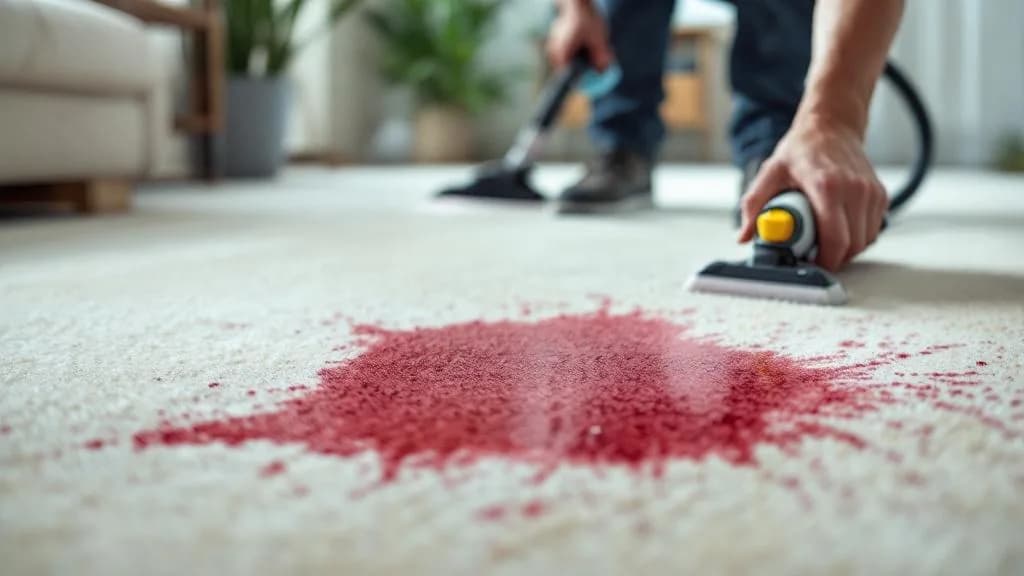
Resin 3D printing (SLA, MSLA, and DLP printing) uses liquid photopolymer resin that cures under UV light. The resin is used in home workshops, hobby rooms, and makerspaces. Spills happen during resin bottle filling, vat handling, failed print removal, and washing parts. Uncured liquid resin is a skin sensitiser and is classified as hazardous: protective gloves are required during any cleanup. The resin also stains carpet and, once cured under UV exposure (including sunlight through a window), becomes a hard polymer that requires mechanical removal.
Wear nitrile gloves during all cleanup
Uncured photopolymer resin is a skin sensitiser: repeated skin contact can cause allergic sensitisation. Always wear nitrile gloves during cleanup. Do not use latex gloves (resin permeates latex). Dispose of resin-contaminated cloths and gloves in sealed bags. Do not place in recycling. If resin contacts skin, wash immediately with soap and water; isopropyl alcohol helps remove resin from skin before soap washing.
Uncured resin on carpet
- Wearing nitrile gloves, blot up as much liquid resin as possible with disposable cloths or paper towels.
- Apply isopropyl alcohol (90% or higher) to a cloth and blot the remaining resin: IPA dissolves uncured photopolymer resin effectively.
- Work from the outside of the spill inward. Change to a fresh cloth section as it picks up resin.
- Follow with dishwashing liquid solution to remove IPA and dissolved resin residue, rinse with warm water, and blot dry.
- Ventilate the room thoroughly: uncured resin fumes are an irritant.
- Dispose of all contaminated cleaning materials in sealed bags.
Cured resin on carpet
- Apply an ice pack over the cured resin for 15 minutes to make it more brittle.
- Use a plastic scraper to break and lift the cured resin from the pile. Work from the edges inward.
- Vacuum the broken resin fragments (wearing gloves: cured resin fragments can be sharp).
- Apply isopropyl alcohol to a cloth and blot the residual resin film in the pile.
- Follow with dishwashing liquid solution, rinse, and blot dry.
Colour staining from pigmented resin
Coloured resins (grey, black, red, blue) contain concentrated pigments that can stain carpet fibres after the resin itself is removed. Isopropyl alcohol blotting after the bulk removal step addresses the pigment residue. For very dark colours, a second IPA treatment round may be needed.
Find a local cleaner in the Sutherland Shire
In the Sutherland Shire? We know your time matters. Leave your enquiry with us and we'll make it our priority to get you a quote from a local cleaner.
Find a Matched Local SpecialistThis site matches enquiries with independent local carpet cleaners. We do not employ cleaners directly.
Get a Shire quote
In the Sutherland Shire? We help you get a quote from a local cleaner. They quote you directly.
Frequently asked
The resin vat tipped over and about 100 ml of grey resin soaked into the carpet in my print room. The room has a window. Will sunlight cure the resin in the carpet?
Yes, photopolymer resin cures under UV light, and sunlight contains UV radiation. If the room has significant sunlight exposure, the resin in the carpet can begin to cure within minutes of sun exposure. Act immediately: close blinds or curtains to block sunlight from the affected area, then begin cleanup with IPA before the resin cures. For a 100 ml spill, use generous amounts of IPA and multiple cloth applications to fully address the volume before any portion cures. Partially-cured resin (tacky but not hard) is harder to remove than either fully liquid or fully cured resin. It does not blot cleanly like liquid resin and does not break cleanly like cured resin. Speed is the priority for a larger uncured spill.
After cleaning up a resin spill with IPA, the carpet in the area feels stiff and slightly tacky. Has the IPA damaged the carpet or is this resin residue?
Tacky residue after IPA treatment is most likely partially dissolved resin that was not fully lifted during the cleaning process. The IPA dissolved the resin surface but some of the dissolved material remained in the pile as the IPA evaporated. Apply a second round of fresh IPA to a clean cloth and blot the tacky area again. This picks up the residual dissolved resin. Follow immediately with dishwashing liquid solution and warm water blotting, which removes both the resin residue and the IPA. The dishwashing liquid step is important for removing the resin residue before the IPA fully evaporates and leaves it behind again. If the stiffness persists after this, a small amount of warm water worked into the pile with a cloth and blotted dry can help remove the last of the residue.
I spilled water-washable resin on the carpet. The product says it is water-washable. Can I just use water?
Water-washable resins are formulated with a hydrophilic component that allows cleanup with water rather than IPA. They are significantly easier to clean from carpet than standard resins. Blot the spill with dry cloths first, then use cold water and dishwashing liquid to clean the affected area. The water-washable formulation means the resin compounds are soluble in water before curing, so the standard dishwashing liquid and water blotting approach is effective without needing IPA. The same curing caution applies: block UV light to prevent curing before cleanup is complete. The same safety handling (nitrile gloves) applies because water-washable resin is still a skin sensitiser before curing.
There is a small cured resin drop on the carpet that I did not notice during printing. It has been there for about two weeks and is very hard. Is this harder to remove than a fresh cured drop?
A two-week-old cured resin drop is fully polymerised and in the same state as a recently cured drop: photopolymer resin does not change significantly after it has fully cured, so age does not make removal harder. The ice-and-scrape method works regardless of how long the resin has been cured. Apply the ice pack, allow adequate chilling, and scrape from the edges. The main variable is how firmly the cured resin has mechanically keyed into the pile structure: a drop that was liquid when it contacted the carpet will have flowed around individual pile fibres before curing, making the mechanical connection between cured resin and pile slightly stronger than a drop that cured on the surface. Patience with the scraping step and firm lateral pressure on the scraper is usually sufficient.