
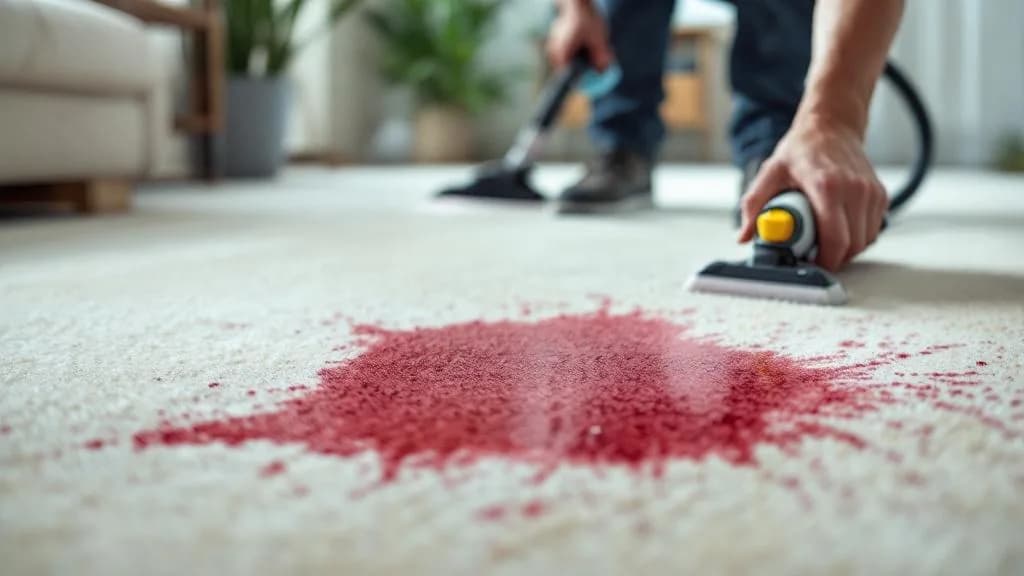
UV-reactive and neon paints achieve their fluorescent effect through fluorophore compounds: organic molecules that absorb ultraviolet light and re-emit it as visible light in the yellow-green, orange, or pink spectrum. These fluorophores are used in acrylic, water-based, and specialist UV body paint formulations. On carpet, the fluorophore compounds bind to synthetic fibres more readily than standard pigments: the same property that makes them glow brightly under blacklight also makes them adsorb to fibres and resist washing. A stain that appears cleaned under normal light may still show significant glow under a blacklight, indicating that fluorophore residue remains in the pile.
Identifying the Paint Type
The treatment approach depends on whether the paint is water-based or solvent-based. Water-based neon and UV paints (which include most craft UV paints, tempera neon, and water-based acrylic neon formulations) are easier to treat, particularly when fresh. Solvent-based UV paints (used for some professional applications and airbrush work) require isopropyl alcohol or paint thinner as a solvent. Treat as you would any solvent-based paint. Most consumer glow paints and party UV paints sold in Australian craft stores are water-based.
Treatment Steps: Water-Based UV Paint
- Blot up as much wet paint as possible immediately. Do not rub.
- Apply cold water and blot to dilute the fluorophore pigment.
- Apply dish soap solution (one teaspoon per two cups cold water) and blot.
- Work from the outer edge inward to prevent spreading.
- Continue blotting until the visible colour is no longer transferring to the cloth.
- For any remaining colour: apply isopropyl alcohol (70% or higher) on a cloth and blot: isopropyl dissolves acrylic binder and helps lift fluorophore residue from synthetic fibres.
- Rinse with cold water blotting after the alcohol step.
- Check under a blacklight once the area is dry to assess residual fluorophore.
Use a blacklight to assess residual fluorophore
After cleaning and drying, check the treated area under a UV blacklight (a small blacklight torch from a hardware or party store works well). If the area still glows under UV, fluorophore pigment remains in the pile. This residue is often invisible under normal lighting but represents incomplete removal. A second round of isopropyl alcohol treatment followed by cold water rinsing will reduce the residual glow further. For most practical purposes, a faint residual glow that is invisible under normal lighting is an acceptable outcome, only a professional extraction cleaning with solvent injection is likely to fully eliminate the UV fluorescence.
Dried UV Paint
Dried water-based UV paint on carpet forms a hard acrylic film: the same as any dried water-based acrylic. The binder (acrylic polymer) has dried and cross-linked around the fluorophore pigment. Re-wetting with cold water partially softens the binder, allowing some to be blotted out, but dried acrylic is never as easily removed as wet paint. Apply cold water and allow three to four minutes of contact time to soften the binder. Scrape gently with a blunt-edged tool to break the dried film into smaller pieces that can be blotted out. Then apply isopropyl alcohol (70%+) to dissolve the remaining binder: the alcohol is most effective on dried acrylic, where it penetrates the cross-linked polymer and softens it. Blot with firm pressure, rinse with cold water, and check under a blacklight.
Find a local cleaner in the Sutherland Shire
In the Sutherland Shire? We know your time matters. Leave your enquiry with us and we'll make it our priority to get you a quote from a local cleaner.
Find a Matched Local SpecialistThis site matches enquiries with independent local carpet cleaners. We do not employ cleaners directly.
Get a Shire quote
In the Sutherland Shire? We help you get a quote from a local cleaner. They quote you directly.
Frequently asked
UV body paint got on the carpet at a party. It was the type marketed as washable. Is it easier to remove?
UV body paints marketed as washable are formulated with water-soluble binders rather than cross-linking acrylic. They are designed to wash off skin with soap and water. On carpet, this makes them significantly easier to treat than standard acrylic UV paint. Cold water and dish soap treatment removes most of the visible colour. The fluorophore pigment may still show some residual glow under a blacklight even after the visible stain is gone, because the fluorophore compounds have a degree of fibre affinity regardless of the binder type. For a washable body paint, though, the residual glow after soap-and-water treatment is typically faint and does not represent a practical problem under normal lighting.
My child used neon craft paint and it spilled on the carpet. The colour is very bright orange. Will it fully come out?
Bright neon orange is one of the more persistent fluorescent colours on carpet: the orange fluorophore (typically a rhodamine or perylene-based compound) has strong fibre affinity. A fresh spill treated immediately with cold water and dish soap will remove the majority of the visible colour. Some residual orange tinge may remain, particularly on light or cream carpet. After the dish soap treatment, apply isopropyl alcohol on a cloth and blot. This addresses the remaining fluorophore-binder complex. Allow to dry and assess. A faint residual tinge after full treatment is possible on light carpet. Check under a blacklight to confirm whether the residue is fluorescent (still has active fluorophore) or simply a mild discolouration (the fluorophore has been degraded but a colour trace remains).
There is glow-in-the-dark paint on the carpet (the type that glows green in the dark without a UV light). Is this different?
Glow-in-the-dark paint (phosphorescent paint) uses strontium aluminate or zinc sulphide as the glow compound rather than UV-reactive fluorophores. These are inorganic compounds rather than organic fluorophores, which makes them less prone to fibre binding than UV fluorophores. On carpet, phosphorescent paint behaves more like a standard water-based paint for cleaning purposes. Treat it with cold water and dish soap. The glow pigment particles are suspended in the binder rather than bonded to the fibre the way fluorophores tend to be, so removal is generally more complete with standard treatment. Isopropyl alcohol is still useful as a second-step treatment for any remaining binder residue. Check in the dark after cleaning and drying. If the carpet still glows in that area, phosphorescent pigment particles remain and another treatment round is needed.