
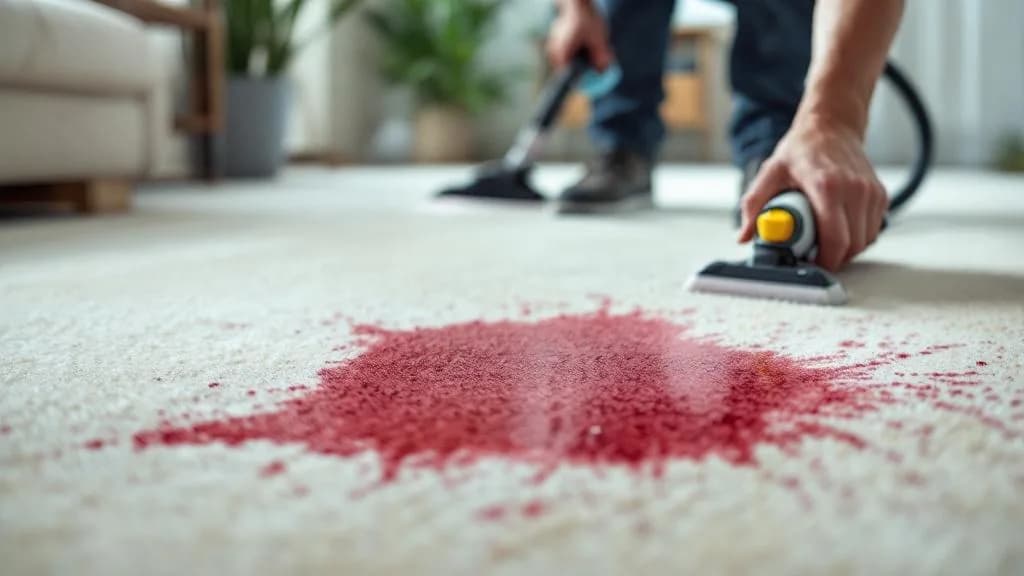
Printer cartridge accidents are among the more alarming carpet stains: the ink is concentrated, often intensely coloured, and can cover a surprising area when a cartridge splits or a toner compartment opens. The critical first step is identifying which type of printer caused the spill, because inkjet ink and laser toner require fundamentally different initial responses. Getting this wrong (particularly rubbing dry toner powder) can embed the stain irreversibly.
Inkjet Ink vs Laser Toner: Identify Your Spill First
| Property | Inkjet Ink | Laser Toner |
|---|---|---|
| Form | Liquid (water or oil-based) | Fine dry powder |
| Colour intensity | Strong: cyan, magenta, yellow, black | Very strong: usually black or CMYK |
| Spread behaviour | Soaks into pile quickly | Sits on surface as powder until disturbed |
| First step | Blot immediately: do not rub | Vacuum carefully: do not wet first |
| Fixative | Alcohol or cold water depending on type | Heat sets toner permanently. Never use hot water |
Treating Inkjet Ink Spills
Inkjet cartridges contain dye-based or pigment-based liquid ink. Dye-based inks (common in photo printers and older consumer printers) are water-soluble: act quickly before they dry. Pigment-based inks (common in office printers and Epson EcoTank systems) are more water-resistant once dry.
- Blot (do not rub) as much liquid ink as possible with dry white paper towel or clean cloth. Work from outside the spill inward.
- For dye-based ink (glossy photo printers): apply cold water sparingly and continue blotting. The diluted ink will transfer to the cloth.
- For pigment-based ink (office printers): apply a small amount of isopropyl alcohol (70%) to a clean cloth and blot. Alcohol breaks down the pigment binder before it cures.
- Follow with a small amount of dish soap in cold water. Apply, blot, then rinse with cold water and blot dry.
- Allow to dry and assess. Pigment-based ink may require a second alcohol treatment if colour remains.
Never use hot water on inkjet ink
Heat partially sets dye-based ink into synthetic carpet fibres. Use cold water only. Similarly, never use a hairdryer to speed drying. Allow the area to air dry and assess colour removal before applying further treatment.
Treating Laser Toner Powder Spills
Laser toner is a fine dry polymer powder fused with pigment. The critical rule is: vacuum before any other action. Toner particles are extremely fine and rubbing or applying liquid immediately embeds them deep into the carpet pile and can spread the affected area significantly.
- Do not rub, blot, or apply any liquid. First, carefully vacuum the loose toner using a vacuum with fine filtration: hold the nozzle just above the surface and use gentle suction to lift powder without agitation.
- After removing all loose powder, apply cold water sparingly to a clean cloth and gently blot any residual toner colour in the pile.
- Apply a small amount of dish soap in cold water, blot gently, then rinse with cold water and blot dry.
- Do not use hot water, a steam cleaner, or iron the area: heat melts toner and permanently fuses it to the fibres.
Toner is a health hazard. Use gloves and ventilate
Laser toner powder is classified as a nuisance dust and can be a respiratory irritant. When dealing with a toner spill, open windows, avoid breathing the airborne powder, and wear disposable gloves. If vacuuming, use a vacuum with HEPA filtration to avoid exhausting fine particles back into the room.
What to Do If Home Treatment Does Not Work
Printer ink (particularly pigment-based inkjet and laser toner) contains compounds specifically engineered to bond permanently to substrates. A significant spill, or one that has dried before treatment, may not fully respond to home methods. Professional carpet cleaners have access to targeted ink remover chemistry and high-powered hot water extraction that can reach deeper into the pile than DIY methods. For toner, specialist application of cold solvent under professional control is sometimes required.
Protecting Home Office Carpet
Many home offices are set up in spare bedrooms or study areas with carpet. Placing a hard-surface chair mat or a small polypropylene rug under the desk and printer area prevents cartridge accidents from reaching the main carpet. Polypropylene mats are easier to clean and tolerate stronger cleaning agents than most carpets.
Find a local cleaner in the Sutherland Shire
In the Sutherland Shire? We know your time matters. Leave your enquiry with us and we'll make it our priority to get you a quote from a local cleaner.
Get a MatchThis site matches enquiries with independent local carpet cleaners. We do not employ cleaners directly.
Get a Shire quote
In the Sutherland Shire? We help you get a quote from a local cleaner. They quote you directly.
Frequently asked
Can printer ink be fully removed from carpet?
Fresh dye-based inkjet ink can often be fully removed with cold water and dish soap if treated immediately. Pigment-based inkjet ink and laser toner are harder: prompt treatment with isopropyl alcohol (inkjet) or careful vacuuming then cold water (toner) removes most of the stain, but set or large spills may leave a residual tint that requires professional treatment.
I rubbed the toner spill and now it is spread and set: what do I do?
Toner that has been rubbed into carpet is significantly harder to remove. Vacuum what you can with a HEPA-filtered vacuum, then apply cold water with dish soap and blot gently. Do not use heat. Contact a professional carpet cleaner. They have cold-solvent products that can help with embedded toner, though some spreading damage may be permanent on light-coloured carpet.
Does isopropyl alcohol damage carpet?
Isopropyl alcohol (IPA) at 70% is generally safe for synthetic carpet (nylon, polyester) in small amounts. It can affect some carpet dyes, particularly on wool or polypropylene, so test on a hidden area first. Use sparingly (apply to a cloth rather than directly to the carpet) and follow with cold water to dilute and remove the alcohol residue.
The ink spill happened yesterday and has dried: is it too late?
Not necessarily, but dried ink is significantly harder to remove than fresh. For dried dye-based ink, try moistening the area with cold water first, then treat with dish soap. For dried pigment-based ink, isopropyl alcohol is still effective on dried deposits. For dried laser toner, professional treatment gives the best outcome. In all cases, avoid rubbing the dried stain.