
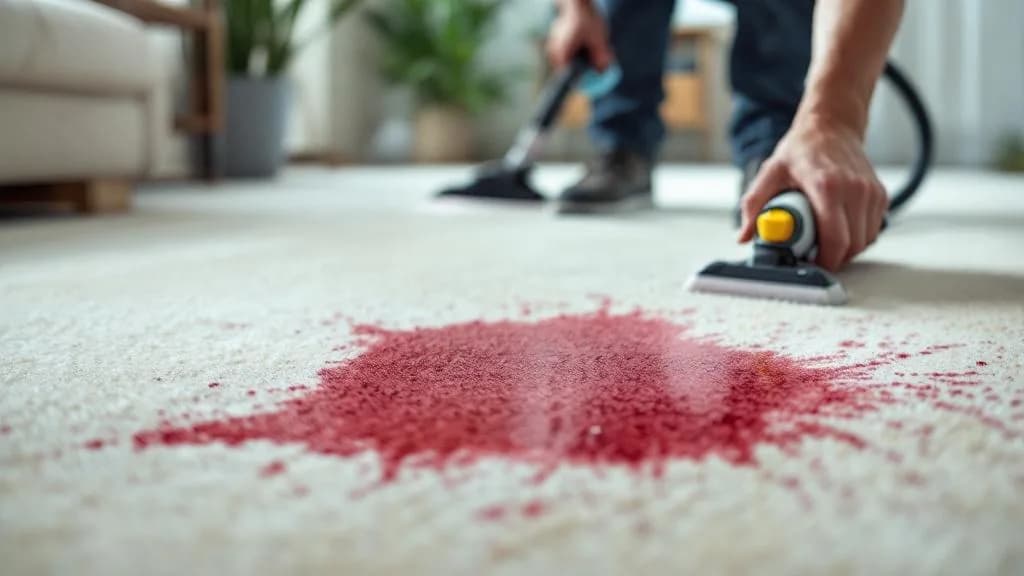
Resin art is a popular hobby: epoxy resin pours, UV resin work, and acrylic fluid art all involve liquid materials that can drip, splash, or spill onto nearby carpet. The critical variable with resin spills is time: liquid resin is soluble and can be removed; cured resin is a polymer solid and is mechanically bonded to carpet fibres. Once cured, removal without damage to the carpet is extremely difficult.
Epoxy Resin (Two-Part A+B)
Epoxy resin is a two-part system (resin and hardener) that cures through a chemical reaction over hours to days. The cure window depends on the formulation: fast-cure epoxies begin to gel within thirty to sixty minutes; slow-cure epoxies may remain workable for hours. For a fresh spill:
- Blot up as much liquid resin as possible immediately with paper towels. Do not rub: blot and lift.
- Apply isopropyl alcohol (70% or higher) to a cloth and blot the residual resin. IPA dissolves uncured epoxy resin effectively. Work from the outside of the spill inward.
- For resin that has begun to gel but not fully cure (tacky stage): acetone (nail polish remover) on a cloth can soften gelled resin. Test on a hidden carpet area first: acetone can affect some carpet dyes and synthetic fibres.
- Follow solvent treatment with dish soap and cold water, blot, and rinse.
UV Resin
UV resin cures only when exposed to UV light (a UV lamp or direct sunlight). In an indoor setting away from UV light, UV resin remains liquid indefinitely. This gives more time to respond than epoxy resin. Treat a fresh UV resin spill the same way as uncured epoxy. Blot and isopropyl alcohol. The critical precaution: do not work near a window or take the carpet outside while still wet with UV resin, as sunlight will cure it in place.
Acrylic Pour Medium
Acrylic pour medium (floetrol, pouring medium, silicone oil) is water-based and significantly easier to remove than epoxy resin. Fresh acrylic pour medium on carpet responds well to cold water and blotting: the medium is water-soluble before drying. Once dried, it forms a flexible film that can be peeled from smooth fibres but is harder to extract from carpet pile. If it has dried in carpet: rehydrate with warm water, allow a few minutes to soften, then blot and scrub gently with a soft brush and dish soap solution.
Fully cured epoxy resin on carpet
Fully cured epoxy resin cannot be dissolved by any solvent that is safe for carpet. It is a cross-linked polymer. Mechanical removal (trimming the bonded fibre tips with sharp scissors) is the only practical approach. For a significant area of cured epoxy on carpet, professional assessment is needed: the only complete fix may be a patch repair using donor carpet.
Find a local cleaner in the Sutherland Shire
In the Sutherland Shire? We know your time matters. Leave your enquiry with us and we'll make it our priority to get you a quote from a local cleaner.
Get a MatchThis site matches enquiries with independent local carpet cleaners. We do not employ cleaners directly.
Get a Shire quote
In the Sutherland Shire? We help you get a quote from a local cleaner. They quote you directly.
Frequently asked
I noticed the epoxy resin spill on my carpet this morning. It happened last night and it is already cured hard. What now?
For a small, fully-cured epoxy spot: use sharp scissors to carefully trim the carpet pile above the cured resin: cut the fibres just above where they are bonded to the resin, not at the backing. This removes the visible hard lump and the bonded fibre tips. The pile will be shorter in that spot but no longer raised or hard. For a large area, a patch repair (cutting out the bonded section and grafting in donor carpet) is the more complete solution.
I was doing resin art and some silicone oil dripped on the carpet. How do I remove it?
Silicone oil is a common resin art additive that creates cells. It is not water-soluble. Apply dish soap directly to a cloth and blot the silicone oil: dish soap's surfactants are one of the more effective agents for silicone. Follow with a water rinse and blot dry. Eucalyptus oil also works on silicone residue. Repeat treatment cycles may be needed as silicone oil is persistent.
My acrylic pour art dripped on the carpet and I missed it. It has dried as a multicoloured film. Can I peel it off?
Dried acrylic medium that has formed a film on top of carpet pile can sometimes be peeled carefully if it has not penetrated to the backing. Work at the edge of the film with a plastic card or fingernail, lifting slowly. If the film is bonded into the fibre and peeling pulls fibres, stop: rehydrate with warm water and dish soap, allow to soften, then work it out gently with a soft brush. Do not force removal as this can damage or pull fibres.