
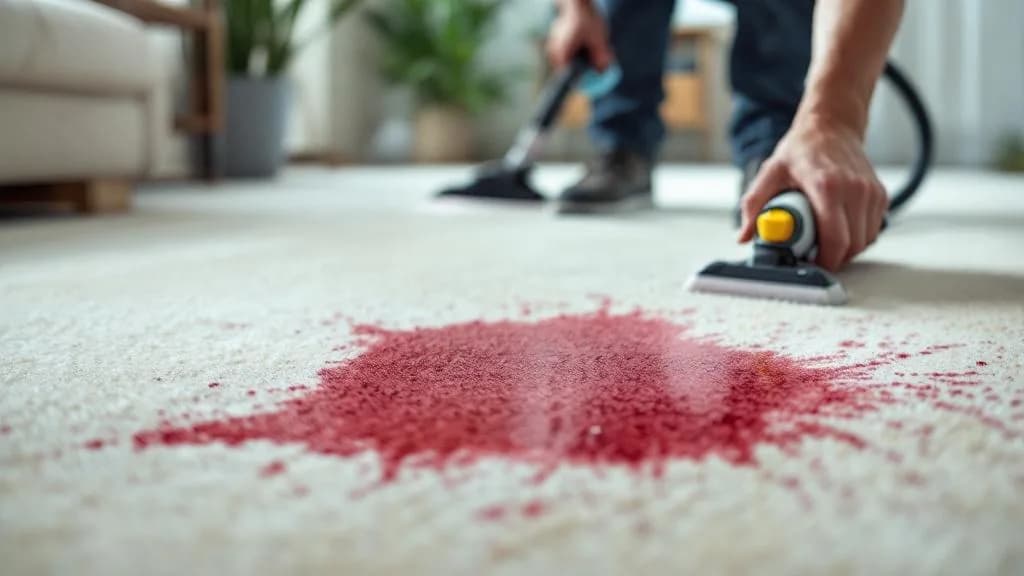
Silly Putty is a silicone polymer compound: viscoelastic, meaning it flows slowly under gentle pressure but fractures under sharp impact. That property is what makes it entertaining for children and difficult for carpets: pressed into pile, it conforms to and grips individual fibres. Pulling it out at room temperature stretches and redistributes it deeper into the pile rather than removing it. The counterintuitive solution is to change its physical state before attempting removal.
The freeze method: primary approach
Chilling Silly Putty causes it to harden and become brittle. It loses its viscoelastic properties and fractures instead of stretching. This makes it possible to break pieces off the carpet pile rather than smearing them further.
- Do not pull or pick at the putty while it is at room temperature. This stretches it into more fibres
- Pack ice cubes in a plastic bag (or use a reusable cold pack) and hold it against the putty for 5–10 minutes until the putty feels hard and brittle when tested with a fingernail
- Once fully chilled, break the putty apart with a blunt object (a spoon or the handle of a butter knife works well) and lift the fractured pieces away from the fibres
- Work quickly: the putty warms back to room temperature in a few minutes at which point it becomes flexible again; re-freeze if needed
- Use a stiff-bristle brush or stiff card to work out any remaining fragments from the pile. Work from the edge of the affected area toward the centre
Freeze spray
Electronics freeze spray (available from hardware stores) is more precise than an ice pack and achieves lower temperatures faster: useful for putty embedded deep in thick pile where an ice pack contact is awkward. Apply in short bursts and work immediately while the compound is brittle.
Removing silicone residue after freezing
Even after the bulk of the putty is removed by freezing and fracturing, a thin silicone residue often remains in the fibres: visible as a slight sheen or tackiness when you run a finger along the pile. Rubbing alcohol (isopropyl alcohol, 70% or higher) dissolves silicone residue effectively.
- Apply a small amount of rubbing alcohol to a clean white cloth. Do not pour directly onto the carpet
- Blot the residue area with the cloth: the alcohol dissolves the silicone polymer and transfers it to the cloth
- Replace the cloth regularly as it picks up residue: using a soiled cloth redeposits material back into the pile
- Once the residue feels clean, blot with cold water to remove alcohol traces, then blot dry
- Allow to air dry fully before walking on the area
Test rubbing alcohol first
Isopropyl alcohol can strip dye from some carpet types, particularly older synthetic carpets with less colour-fast dye lots. Test on a hidden area (inside a wardrobe or under furniture) by applying and blotting. Check for colour transfer to the cloth before treating the visible stain.
Coloured putty and dye transfer
Many modern putty products (Thinking Putty, magnetic putties, glitter putties) contain added pigments or metallic particles. After the silicone compound is removed, a colour stain from the putty dye may remain in the carpet fibres. This is a separate problem from the putty itself and follows the same treatment as fabric dye stains: cold water dilution first, then diluted dish soap, then 3% hydrogen peroxide if the colour persists (patch tested first). The silicone compound and the dye stain should be treated as two separate steps. Remove the compound first, then address any remaining colour.
Find a local cleaner in the Sutherland Shire
In the Sutherland Shire? We know your time matters. Leave your enquiry with us and we'll make it our priority to get you a quote from a local cleaner.
Find a Matched Local SpecialistThis site matches enquiries with independent local carpet cleaners. We do not employ cleaners directly.
Get a Shire quote
In the Sutherland Shire? We help you get a quote from a local cleaner. They quote you directly.
Frequently asked
Does WD-40 remove Silly Putty from carpet?
WD-40 is sometimes suggested as a Silly Putty treatment, and it can work to an extent. It lubricates the silicone compound and can make it less adherent to fibres. However, it leaves an oily residue in the carpet that then requires a separate degreasing treatment. Rubbing alcohol is preferred for carpet because it dissolves the silicone without adding an oil problem.
Can Silly Putty permanently damage carpet?
The putty itself does not chemically damage carpet fibres. It is mechanically adhered rather than chemically bonded. Full removal is achievable in most cases if the freeze-and-fracture method is used. Coloured putty can leave a dye stain that may be harder to fully remove. Walking on embedded putty before treatment can push it deeper into backing, which makes removal harder.
My child pressed Silly Putty into the carpet and it's dried out: is it harder to remove?
Aged or partially dried Silly Putty is actually easier to remove than fresh putty because it has already started to lose its viscoelastic flexibility. The freeze method still works. It becomes fully brittle faster. The challenge with older putty is that it may have been partially walked on and pushed into backing fibres, requiring more patient work with a stiff brush after the freeze step.
What about Thinking Putty or magnetic putty in carpet?
Magnetic putty contains iron filings in a silicone base. Treat the silicone compound the same way with freezing and rubbing alcohol, but be aware that the iron particles can be drawn further into the pile if you use a magnet near the stain. Keep magnets away from the area until the putty is fully removed. Thinking Putty (by Crazy Aaron) is pure silicone polymer: the freeze method works well on it.