
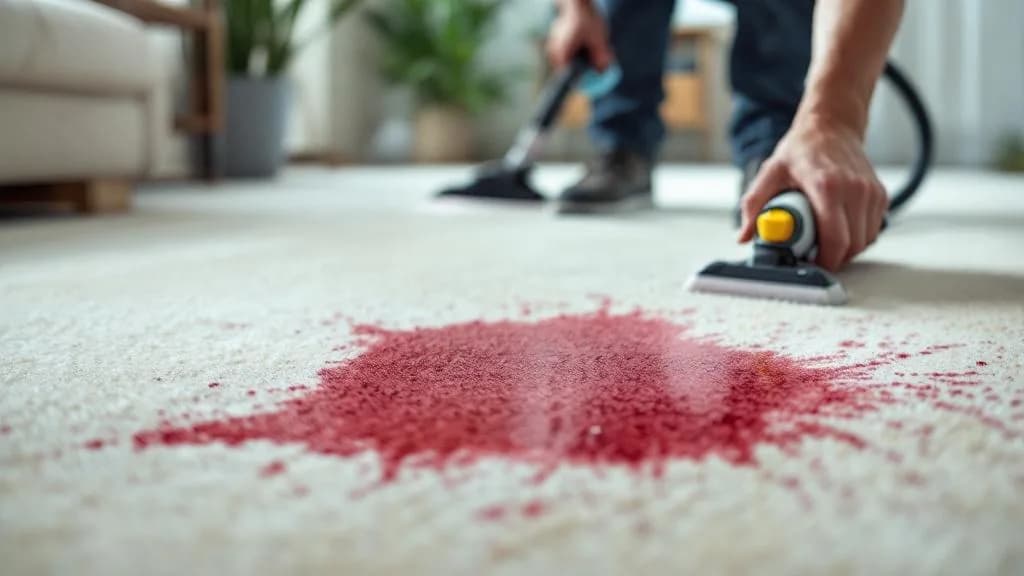
Slurpees and similar frozen beverages look relatively harmless when spilled: the drink is mostly ice and water. But as the ice melts into the carpet, it releases highly concentrated artificial food dye into the pile. The dye spreads with the meltwater, often covering a wider area than the initial spill, and begins bonding to carpet fibres within minutes. Blue, red, and purple frozen drinks are among the more challenging stain colours on light carpet.
Why frozen drink stains spread
The ice component acts as a time-delayed delivery mechanism. Initially, the spill seems contained, but as the ice sits on the carpet and melts, dye-saturated liquid spreads outward under the pile. The stain footprint is usually larger than the visible initial spill. Lifting the cup away from the carpet quickly reduces the amount of liquid available to spread.
Immediate treatment
- Remove any ice pieces immediately. Do not allow them to continue melting into the carpet.
- Blot up as much liquid as possible with white paper towels. Press firmly and lift, working inward from the outer edge of the spill.
- Apply cold water (not warm: heat sets food dye) to the stained area with a cloth and continue blotting. This dilutes the dye concentration.
- Mix one tablespoon of dish soap with two cups of cold water. Apply a small amount and blot again.
- Apply an enzyme-based stain remover if available. The enzyme treatment addresses the colour compounds more thoroughly than detergent alone.
- Rinse with cold water blotting and allow to dry fully.
- Check the stain when dry: dye stains can appear lighter when wet and darker when dry.
Cold water only
All food dye stains respond to cold water. Warm or hot water causes the dye molecules to swell and penetrate deeper into the fibre, making the stain harder to remove. Use cold water throughout the entire treatment process.
For blue and purple frozen drink stains
Blue and purple food dyes (typically FD&C Blue No. 1 or a mix of red and blue dyes) are among the most persistent on carpet because they bond readily to protein fibres. On synthetic carpet (nylon, polyester), they are somewhat easier to treat than on wool. After cold water and detergent treatment:
- Apply rubbing alcohol to a white cloth and dab the remaining colour. Alcohol can lift direct food dyes from synthetic fibres.
- For persistent blue or purple on light synthetic carpet, a diluted hydrogen peroxide solution (one part 3% peroxide to four parts water) can be applied. Test on a hidden area first.
- On wool carpet, use only wool-safe enzyme cleaners. Avoid peroxide and alcohol on wool.
Dried or set frozen drink stains
A frozen drink stain that dried before treatment has allowed the dye to bond more firmly. Rehydrate the area with cold water first, allow two to three minutes, then proceed with the detergent and enzyme treatment. Dried food dye stains typically require more treatment cycles than fresh stains.
Find a local cleaner in the Sutherland Shire
In the Sutherland Shire? We know your time matters. Leave your enquiry with us and we'll make it our priority to get you a quote from a local cleaner.
Find a Matched Local SpecialistThis site matches enquiries with independent local carpet cleaners. We do not employ cleaners directly.
Get a Shire quote
In the Sutherland Shire? We help you get a quote from a local cleaner. They quote you directly.
Frequently asked
My child spilled a blue Slurpee on the cream carpet and it is now bright blue. Is this fixable?
Blue food dye on cream carpet is one of the more visible stain scenarios, but it is treatable if addressed promptly. The cold water, detergent, and enzyme treatment should lift the majority of the colour. Remaining blue tint on cream synthetic carpet may respond to diluted hydrogen peroxide. Test in a hidden area first. A professional carpet clean with a dye-specific pre-treatment can address colour that remains after home treatment.
The ice melted and the stain is much bigger than the cup. How do I approach a large stain?
Work outward from the centre but blot inward: the goal is to lift dye from the outer edges first to stop the stain spreading further as you add treatment liquid. Apply cold water and detergent in sections across the full stained area. For a large stain, a carpet cleaning machine on the cold-rinse setting is more practical than hand blotting for a full rinse pass.
Can I use vinegar on a Slurpee stain?
White vinegar in diluted form (one part vinegar to two parts water) can help with odour and may assist in lifting some dye molecules, but it is less effective than enzyme cleaner for food colouring stains. Use it as a secondary rinse step after the detergent treatment if you do not have enzyme cleaner available, but enzyme-based products are the more effective primary treatment.
The stain looks clean when wet but the colour reappears as the carpet dries. Why?
This is wicking: dye from the carpet backing or underlay is being drawn back up through the pile as the moisture evaporates. Press a clean weighted towel onto the damp area after cleaning and leave it overnight. This draws the residual dye upward into the towel rather than back into the pile. Repeat the enzyme treatment once the carpet is dry to address any wicked dye.