
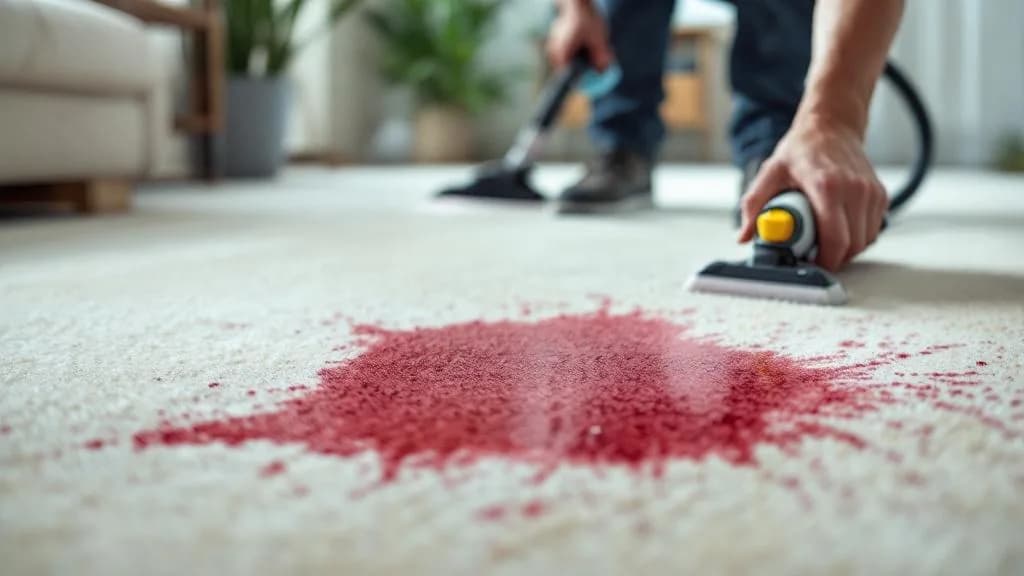
Gravy boat spills happen at the dinner table: the ceramic jug is knocked or tipped, sending hot gravy across the dining area carpet. Gravy contains meat drippings (fat and protein from the roasting pan), stock (Maillard browning compounds that create the dark colour), and a starch thickener (flour or cornstarch). All three components need to be addressed: the fat with dish soap, the protein with enzyme cleaner, and the dark brown colour with hydrogen peroxide on light carpet. The enzyme cleaner step is the most important for long-term results: protein from meat stock left in carpet fibres will produce a progressively unpleasant meaty smell as it breaks down over the following days.
Cleaning steps
- Blot the gravy immediately with a dry cloth. Gravy is served hot, which means it penetrates carpet pile quickly: act immediately.
- Apply cold water and blot to dilute the gravy and begin flushing out the starch and protein. Do not use hot water: heat cooks the meat protein into carpet fibres and sets the stain.
- If the gravy is high in fat (pan drippings or butter-enriched), sprinkle cornflour over the spill to absorb the fat, then vacuum it up before the dish soap step.
- Apply dish soap solution (1 teaspoon per cup of cold water) and blot. This emulsifies the fat component from the meat drippings.
- Apply enzyme cleaner and allow 15–20 minutes dwell time. This is the critical step: enzyme cleaner breaks down the meat protein and stock compounds that dish soap cannot address and that cause the meaty smell.
- Rinse with cold water blotting until soap is fully removed.
- For dark brown colour remaining on light carpet: apply 3% hydrogen peroxide, allow 5–10 minutes, blot, and rinse. The Maillard browning compounds in the stock respond to hydrogen peroxide oxidation.
- Allow to air-dry.
Do not skip the enzyme cleaner step
Gravy contains meat stock protein that produces a distinct meaty or "dog food" smell in carpet if not fully broken down. This smell often does not appear immediately. It develops over 1–3 days as the protein begins to decompose in the fibres. The enzyme cleaner step prevents this. If you notice a meaty smell developing after the initial clean, apply enzyme cleaner again with an extended dwell time.
Gravy with wine, soy sauce, or dark beer
Gravy enriched with red wine, soy sauce, or dark beer carries additional colour compounds beyond the standard Maillard browning from stock reduction. Red wine adds anthocyanin pigment; soy sauce adds dark Maillard pigment and salt; dark beer adds roasted malt colour compounds. These additions do not change the treatment approach, but make the dark colour on light carpet more resistant to a single hydrogen peroxide round. For red wine gravy or soy-enriched gravy staining light carpet: apply two rounds of hydrogen peroxide (allowing each to dry between applications) rather than a single round. The protein and fat components are treated identically regardless of enrichment.
Packet, chicken and roast beef gravy
- Packet gravy mix: high in salt and caramel colouring but lower in fat: the brown colour is the main concern, and light carpet may need more than one hydrogen peroxide round.
- Chicken gravy: less fat than beef gravy and a paler brown mark; hydrogen peroxide still helps on light carpet.
- Roast beef gravy: the highest fat content. Use the cornflour step before the dish soap.
Find a local cleaner in the Sutherland Shire
In the Sutherland Shire? We know your time matters. Leave your enquiry with us and we'll make it our priority to get you a quote from a local cleaner.
Find a Matched Local SpecialistThis site matches enquiries with independent local carpet cleaners. We do not employ cleaners directly.
Get a Shire quote
In the Sutherland Shire? We help you get a quote from a local cleaner. They quote you directly.
Frequently asked
The gravy spilled at Christmas dinner and was not cleaned until the next morning. The carpet now has a dark dried stain and smells meaty. Is it too late to treat it?
Dried gravy is harder to treat than fresh but still removable. Re-hydrate the dried gravy with cold water. Apply water and allow 5 minutes for the dried starch and protein crust to soften before blotting. Once re-hydrated, the spill can be treated with the standard sequence: dish soap, enzyme cleaner (particularly important for a day-old spill where decomposition of the protein has begun and the smell has developed), and hydrogen peroxide for colour. For a day-old meaty smell, apply enzyme cleaner with a 30-minute extended dwell time rather than the standard 15 minutes, and cover the area with a damp cloth during treatment to slow evaporation. A second enzyme cleaner application once the first has dried is often needed for day-old protein spills.
The gravy spilled on a cream carpet runner under the dining table. The runner is woven with a loop pile. Does the loop pile change the treatment?
Loop pile carpet holds spills in the loop structure rather than allowing them to penetrate straight down into the pile like cut pile. This means the gravy may have spread more laterally within the loops before penetrating deeply. Blot carefully without pulling or snagging the loops. Use a flat cloth pressed gently rather than a rubbing motion. Apply the dish soap and enzyme cleaner steps as normal, but take care not to oversaturate the loop pile: water can wick under the loops and spread the stain laterally. The hydrogen peroxide step on cream loop pile should be applied carefully; if the cream colour is a dye rather than the natural fibre colour, test on an inconspicuous area before applying over the full stain.
I make vegetarian "gravy" from yeast extract (Vegemite or Marmite) and vegetable stock. Is this treated the same as meat gravy?
Vegetarian yeast extract gravy is a very different stain from meat gravy. Yeast extract is extremely dark (almost black), highly concentrated, and leaves an intense colour stain. It contains no meat protein, so the enzyme cleaner step for meat decomposition is not needed. The dark colour requires hydrogen peroxide. Apply cold water and dish soap to remove the oil component from any added fat, then apply hydrogen peroxide to the dark stain and allow 5–10 minutes. Multiple hydrogen peroxide rounds are typically needed for strong yeast extract staining. The starch thickener component responds the same as in meat gravy. The smell from yeast extract gravy is savoury but does not decompose unpleasantly in carpet the way meat protein does: the smell concern from meat gravy is not present with vegetarian gravy.