
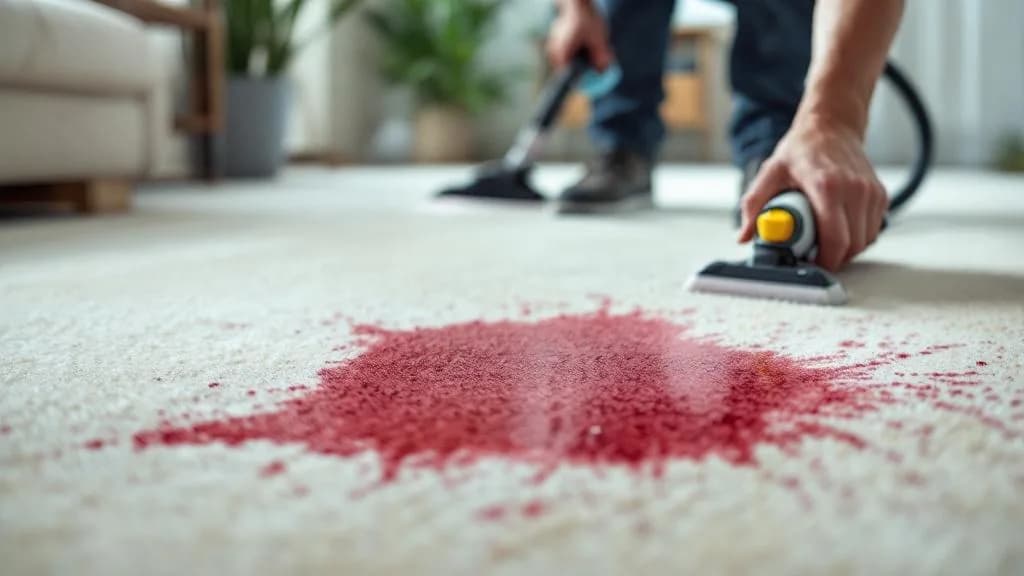
Kefir is fermented milk made with live bacterial and yeast cultures, producing a thin, drinkable consistency similar to a runny yogurt. Its liquid consistency means a kefir spill spreads across carpet much faster than thicker dairy products: a tipped bottle or knocked-over glass will cover a wide area before blotting can begin. Kefir contains dairy fat, casein protein, and a complex mix of fermentation acids and yeast compounds. The fermented yeast component gives kefir a more pungent smell in carpet than plain milk, and the enzyme cleaner step is essential to prevent this smell from establishing in the fibres.
Cleaning steps
- Blot immediately with every dry cloth available. Kefir's thin consistency means it penetrates quickly: act fast to limit the depth of penetration.
- Apply cold water and blot to dilute the kefir. Cold water is important because kefir contains dairy protein (casein) that bonds to carpet fibres when exposed to heat.
- Apply dish soap solution (1 teaspoon per cup of cold water) and blot to emulsify the dairy fat component.
- Apply enzyme cleaner and allow 15 minutes dwell time. This step breaks down both the casein dairy protein and the yeast and bacterial fermentation by-products that produce the sour-fermented smell.
- Rinse with cold water blotting until soap is fully removed.
- Allow to air-dry. Check by smell once dry: any residual sour or fermented smell means the enzyme cleaner step needs repeating.
- If smell persists after a second enzyme round: apply baking soda, allow overnight, vacuum to absorb residual volatile compounds.
Kefir spreads further than it looks
Because kefir is thin, it wicks laterally through carpet pile beyond the visible wet area. Before starting treatment, check the surrounding 30–40 cm of carpet with your hand. If it feels cool or damp, the kefir has spread there. Treat the full damp radius with the enzyme cleaner step, not just the visible stain. Untreated protein in the outer wicking zone will also develop a sour smell.
Flavoured and fruit kefir
Plain kefir is treated with the steps above. Flavoured kefir adds components based on the flavour:
- Strawberry or berry kefir: adds anthocyanin pigment, after the enzyme cleaner step, apply hydrogen peroxide to any remaining pink or red colour and allow 5 minutes before blotting and rinsing.
- Mango or tropical kefir: adds carotenoid pigment (orange tinge). Treat the colour with hydrogen peroxide if visible on light carpet.
- Vanilla kefir: adds minimal staining but the vanilla and sugar component makes the area slightly sticky: the dish soap step addresses this.
- Green kefir (with spirulina or spinach): adds chlorophyll: hydrogen peroxide addresses any remaining green tinge.
Find a local cleaner in the Sutherland Shire
In the Sutherland Shire? We know your time matters. Leave your enquiry with us and we'll make it our priority to get you a quote from a local cleaner.
Find a Matched Local SpecialistThis site matches enquiries with independent local carpet cleaners. We do not employ cleaners directly.
Get a Shire quote
In the Sutherland Shire? We help you get a quote from a local cleaner. They quote you directly.
Frequently asked
I knocked over a 1-litre bottle of kefir. The kefir has spread across the dining area carpet in a large wet patch. How do I manage a litre of liquid dairy on carpet?
A litre of kefir on carpet is a significant moisture event: the liquid will have penetrated the carpet pile and likely reached the underlay. Immediate maximum blotting is critical: use every available dry towel, stand on them, and replace as they saturate. A wet-dry vacuum extracts far more liquid than towel blotting for this volume. After maximum extraction, apply dish soap across the full affected area and blot. Apply enzyme cleaner across the full area with 20 minutes dwell time: covering the area with a damp cloth (not wet) slows evaporation and improves enzyme contact with the protein in the deeper pile layers. Rinse in sections. The underlay concern: if the kefir has reached the underlay, the dairy protein there will produce a persistent smell. Check the underlay by lifting the carpet edge; if damp, use a fan directed under the lifted edge to dry it while blotting from above.
My kefir spill is on a bedroom carpet that has underfloor heating. The heating is currently on and the carpet is warm. Does the warm carpet change anything?
Warm carpet from underfloor heating is a significant concern for a dairy protein spill: the heat accelerates the denaturing of casein protein and speeds up the fermentation of the bacterial and yeast cultures in the kefir. Turn the underfloor heating off immediately after the spill is discovered and do not turn it back on until the carpet is fully dried and the enzyme cleaner treatment is complete. The heat was working against you for the time it was on before you noticed. This makes the enzyme cleaner step even more important, and a longer 20-minute dwell time is recommended rather than the standard 15 minutes. Do not use warm water for any treatment step with the underfloor heating already having warmed the carpet.
I make homemade water kefir (using water, sugar, and water kefir grains: no dairy). Is the treatment the same as for dairy kefir?
Water kefir is fundamentally different from dairy kefir. It contains dissolved sugar, fermentation by-products (including trace alcohol, lactic acid, and CO2), and water kefir grain residue, but no dairy fat and no casein protein. The sour dairy smell concern is absent. Treatment for water kefir is simpler: blot immediately, apply cold water and blot to dilute the sugar and acid components, apply dish soap solution to address any residual fermentation oils, and rinse thoroughly. No enzyme cleaner is needed for the protein step. If the water kefir was flavoured with fruit juice or flavouring (many water kefirs are), add the appropriate treatment for the flavouring: hydrogen peroxide for berry or citrus colour, dish soap for fruit oils. The baking soda neutralisation step is worth doing if the spill is large on coloured carpet, as water kefir is mildly acidic.