
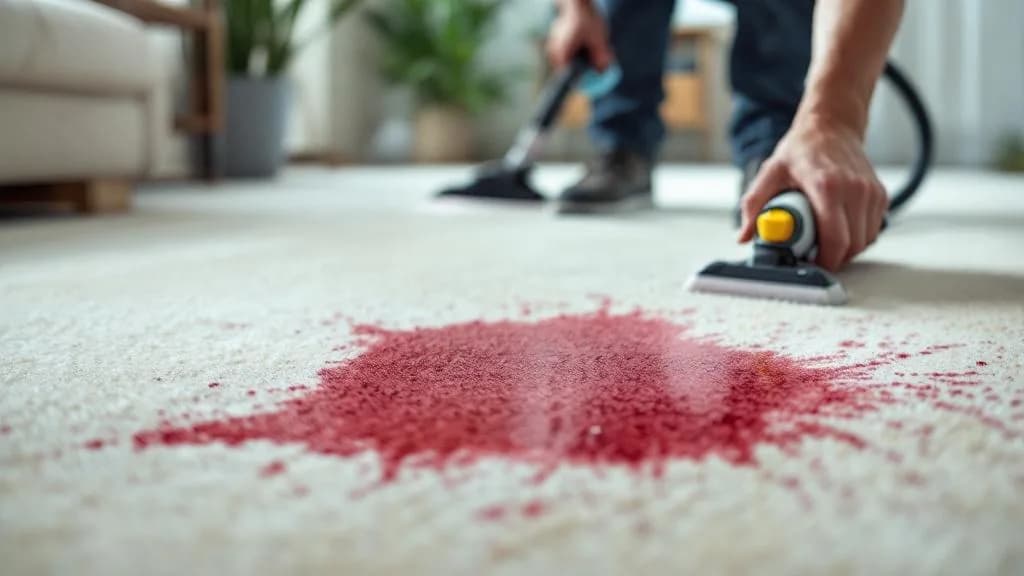
Malt vinegar is produced by fermenting malted barley into beer, then fermenting that beer further into vinegar: the result is an acetic acid solution (typically 5–8% acidity) with a dark brown colour from the malted barley. It is used as a condiment for fish and chips, in pickling, and in cooking. A malt vinegar spill on carpet presents three problems: the acidity (which can damage carpet dyes and fibres if left to concentrate as it dries), the dark brown colour, and the very sharp vinegar smell. The acid neutralisation step is the most important. It stops further fibre damage and slows the colour-setting process.
Cleaning steps
- Blot immediately with a clean cloth to remove as much vinegar as possible before it penetrates deeper.
- Apply cold water and blot to dilute the acetic acid concentration. This is the most important early step: diluting the acid reduces the risk of dye damage and fibre weakening.
- Apply baking soda to the damp area and allow 5 minutes. Baking soda neutralises the acetic acid (it fizzes slightly on contact). Blot up the baking soda once it has reacted.
- Apply dish soap solution (1 teaspoon per cup of cold water) and blot to address any residual organic compounds in the malt vinegar.
- Rinse with cold water blotting to remove all soap and baking soda residue.
- On light carpet with remaining brown discolouration: apply hydrogen peroxide (3%) to the stained area, allow 5 minutes, and blot. Test a hidden area first.
- Allow to air-dry. The vinegar smell dissipates as the acetic acid evaporates. If any smell remains after drying, a second baking soda application (overnight, then vacuum) completes the odour treatment.
Acid damage risk for wool and natural fibre carpet
Wool carpet uses acid dyes: dyes applied in an acid bath that bond to the wool fibre. Strong acid spills (including malt vinegar) can strip or shift these dyes if left in contact for extended time, or if concentrated by drying without dilution. On wool carpet, the cold water dilution and baking soda neutralisation steps must happen as quickly as possible after the spill. Do not allow malt vinegar to dry into wool carpet without first diluting and neutralising. On synthetic carpet (nylon, polyester, polypropylene), acid damage risk is much lower.
Malt vinegar versus other vinegars
Different vinegars share the acetic acid treatment approach but differ in colour and secondary components:
- White vinegar: no colour concern, same acid treatment: no hydrogen peroxide step needed.
- Apple cider vinegar: pale golden colour, same acid treatment: hydrogen peroxide for any pale yellow residue on white carpet.
- Balsamic vinegar: very dark brown-black colour and much higher sugar content: the hydrogen peroxide step is important for colour, and thorough rinsing for the sugar.
- Red wine vinegar: adds red anthocyanin colour from the original red wine: hydrogen peroxide addresses this after the acid neutralisation steps.
- Rice vinegar: lower acidity and no significant colour: gentler treatment, same neutralisation steps but less urgency on the colour step.
Find a local cleaner in the Sutherland Shire
In the Sutherland Shire? We know your time matters. Leave your enquiry with us and we'll make it our priority to get you a quote from a local cleaner.
Find a Matched Local SpecialistThis site matches enquiries with independent local carpet cleaners. We do not employ cleaners directly.
Get a Shire quote
In the Sutherland Shire? We help you get a quote from a local cleaner. They quote you directly.
Frequently asked
A bottle of malt vinegar fell off the kitchen bench and rolled across the floor, dripping as it went. There is a long trail of small drops across the carpet. How do I treat a vinegar drip trail?
A drip trail of malt vinegar needs to be treated across the full length of the trail: every drip point contains acetic acid and dark brown pigment. Apply baking soda generously across the entire trail (not just the most visible drops) and allow 5 minutes to neutralise the acid across all contact points. Then work along the trail section by section: cold water blot, dish soap, rinse. For a long trail on light carpet, hydrogen peroxide applied along the trail addresses any remaining brown discolouration from the malt. Working in sections prevents the wet treatment in one section from spreading to an adjacent section before you reach it. Do not skip less visible drip points: dried small drops of malt vinegar leave a dark spot that is more obvious against light carpet once fully dry.
The malt vinegar spill dried before I found it. The area has a hard dark patch and a sharp vinegar smell even after drying. How do I treat dried malt vinegar?
Dried malt vinegar leaves concentrated acetic acid and dark malt pigment bonded to carpet fibres: the smell persists because acetic acid continues to off-gas from the concentrated residue in the pile. The neutralisation step is even more important for dried vinegar than fresh: apply baking soda to the dry patch and allow 10 minutes to react with the concentrated acid in the fibres. You may notice fizzing even on a dry-looking stain as moisture in the air activates the reaction. After the baking soda step, apply cold water and blot to rehydrate and dilute the dried residue, then proceed with dish soap, rinse, and hydrogen peroxide for the dark colour on light carpet. A second baking soda application overnight after the full treatment handles any remaining sharp smell: the baking soda adsorbs the remaining acetic acid vapour from the pile.
We had fish and chips on the lounge room floor and malt vinegar splashed on the carpet, but there is also grease from the chips and possibly some tartar sauce. How do I treat this compound spill?
Fish and chips vinegar splatter typically combines malt vinegar (acid and dark colour), cooking oil or chip grease (fat), and possibly tartar sauce (mayonnaise base: fat and egg protein). The acid treatment for the vinegar and the fat treatment for the grease are handled in the same sequence: cold water and baking soda for the vinegar acid first (most time-sensitive), then dish soap for the cooking oil and any mayonnaise fat. If tartar sauce is present, apply enzyme cleaner after the dish soap step to address the egg protein component from the mayonnaise base. Hydrogen peroxide for any remaining dark malt vinegar colour on light carpet. The tartar sauce adds a creamy, pale component that generally does not cause visible staining but can leave a slight fat residue: the dish soap step addresses this. The vinegar smell will dissipate as the acetic acid evaporates once the acid is diluted and the area is clean.