
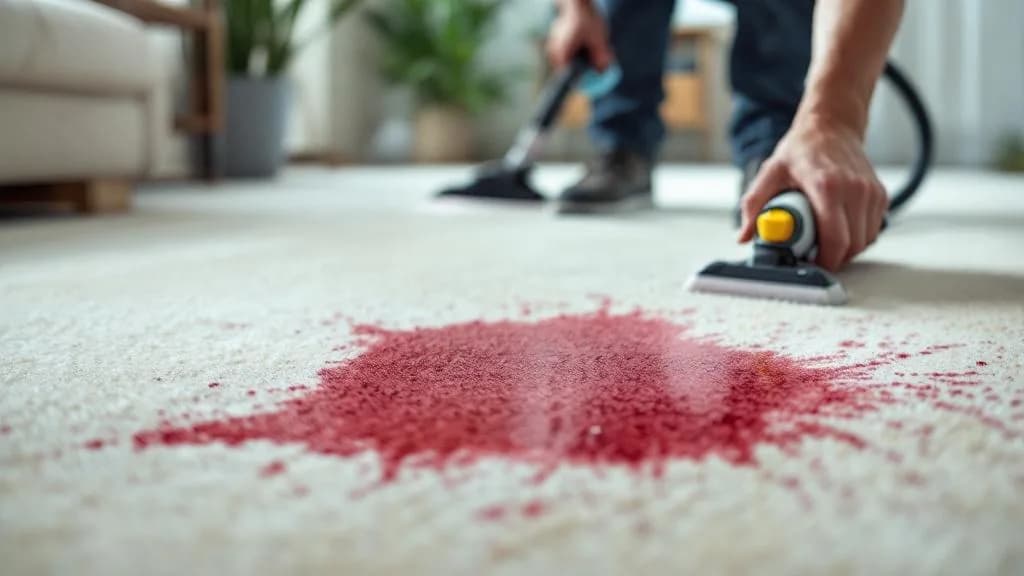
A curry spill is one of the more complex carpet stain scenarios because it is never a single substance. Whether it is a rich korma, a dry rub spice blend, or a lentil-based dhal, curry contains multiple staining components that each require a different chemical approach. Treating only the visible colour (the yellow turmeric pigment) while leaving the oil or protein residue behind is why many curry stains seem to reappear after surface cleaning.
What Is in a Curry Stain: The Four Components
- Oil or ghee carrier: most curry dishes are cooked in oil, ghee, or coconut cream. The oil phase is the first thing to address: it is fat-soluble and will not respond to water. Leaving the oil component in the carpet pile causes the stain to attract soil over time and makes the other components harder to lift.
- Curcumin (turmeric) pigment: the yellow pigment in turmeric is a polyphenol compound that bonds strongly to carpet fibres and is notoriously persistent. It is pH-sensitive: it is yellow in neutral and acidic conditions, and shifts to red-brown in alkaline conditions (which is why applying some household cleaners to a turmeric stain can turn it red).
- Paprika and chilli carotenoids: the orange-red pigments from paprika and chilli are carotenoids similar to lycopene. Fat-soluble, like the curcumin, and require degreaser treatment rather than water alone.
- Protein from yoghurt, cream, or coconut milk: many curry dishes contain protein-rich dairy (yoghurt-based marinades, cream) or coconut milk. The protein component behaves like a milk or blood stain: it denatures under heat and bonds to the fibre. Cold water and enzyme treatment address the protein layer.
Cold water, not hot, and no alkaline cleaners
Hot water denatures the protein component and sets it permanently in the fibre. Alkaline household cleaners turn curcumin red-brown and make the stain harder to remove. Use cold water only, and avoid general-purpose spray cleaners on curry stains.
Treatment Sequence: Layer by Layer
- Remove surface curry immediately with a spoon or card. Blot (do not rub) with cold water to dilute. Remove as much bulk as possible.
- Address the oil/fat layer first: apply dish soap concentrate (a small amount, undiluted or 2:1 concentrate with water) and work gently into the pile. Dish soap is formulated to cut through fat and oil: the same principle as removing cooking grease. Blot, do not rub. Repeat until oily residue is reduced.
- Apply an enzyme cleaner for the protein component: if the curry contained yoghurt, cream, or coconut milk, apply an enzyme cleaner (protease/lipase type, same as for pet stains or milk spills) and allow 5–10 minutes dwell time. Blot to lift the protein residue.
- Address the curcumin pigment: apply a small amount of white vinegar (acidic) to the area after the oil and protein layers are treated. This acidifies the curcumin and prevents it shifting to the red-brown alkaline form. Blot gently.
- Rinse with cold water and blot dry. Assess the remaining colour in good light.
- For persistent yellow shadow: 3% hydrogen peroxide on a cloth (test in hidden area first; do not use on wool) oxidises curcumin pigment and reduces the yellow discolouration. Apply, allow 10 minutes, rinse.
By Curry Type
| Curry Type | Dominant Components | Treatment Emphasis |
|---|---|---|
| Korma / butter chicken (cream-based) | High oil/cream, curcumin, paprika | Dish soap for oil and cream; enzyme cleaner for protein; H2O2 for curcumin |
| Rogan josh / tikka masala (tomato-based) | Tomato, paprika, oil, curcumin | Dish soap first; H2O2 for lycopene+curcumin; cold water throughout |
| Dhal / lentil curry | Turmeric, oil, protein from lentils | Dish soap for oil; enzyme for lentil protein; vinegar then H2O2 for curcumin |
| Dry curry powder / spice rub | Concentrated pigments, minimal liquid | Vacuum dry powder first; then dish soap; H2O2 for concentrated pigments |
| Thai green/red curry (coconut milk) | Coconut fat, green/red pigments, protein | Dish soap for coconut oil; enzyme for protein; treat colour pigments last |
Find a local cleaner in the Sutherland Shire
In the Sutherland Shire? We know your time matters. Leave your enquiry with us and we'll make it our priority to get you a quote from a local cleaner.
Find a Matched Local SpecialistThis site matches enquiries with independent local carpet cleaners. We do not employ cleaners directly.
Get a Shire quote
In the Sutherland Shire? We help you get a quote from a local cleaner. They quote you directly.
Frequently asked
How do you remove curry from carpet?
Remove surface curry with a spoon, blot with cold water to dilute. Apply dish soap to address the oil/fat layer. Follow with enzyme cleaner if the curry contained dairy or coconut milk. Apply white vinegar to keep the curcumin pigment in its yellow (more removable) form. For remaining yellow shadow, 3% hydrogen peroxide on a cloth can oxidise the curcumin. Cold water throughout: never hot.
Why does my curry stain turn red when I clean it?
Curcumin (the yellow pigment in turmeric) is pH-sensitive. It is yellow in neutral and acidic conditions but shifts to red-brown in alkaline conditions. Many household spray cleaners are alkaline, which turns the yellow curcumin stain into an orange-red mark that is harder to remove. Use white vinegar (acidic) rather than alkaline cleaners when treating curry stains: the acidity keeps the curcumin in its yellow form, which is more responsive to subsequent treatment.
Can curry stains be fully removed from carpet?
Fresh curry treated promptly with the correct sequence (oil first, then enzyme, then acid + H2O2 for pigment) is often significantly reducible and sometimes fully removed on synthetic carpet. Dried curry that has been left for more than a few hours, large spills, or curry on wool carpet is harder: the curcumin bonds progressively more strongly as it ages. Professional treatment can reduce stubborn curry stains considerably but cannot guarantee complete removal for fully set curcumin pigment.
I used a household spray cleaner on a curry stain and it turned red-brown. What do I do?
The alkaline cleaner has converted the curcumin to its red-brown form. Apply white vinegar to the area to re-acidify it. This may shift some of the red-brown colour back toward yellow. Then treat with 3% hydrogen peroxide to oxidise the pigment. The red-brown form of curcumin is harder to remove than the yellow form, so results depend on how deeply the alkaline cleaner penetrated.