
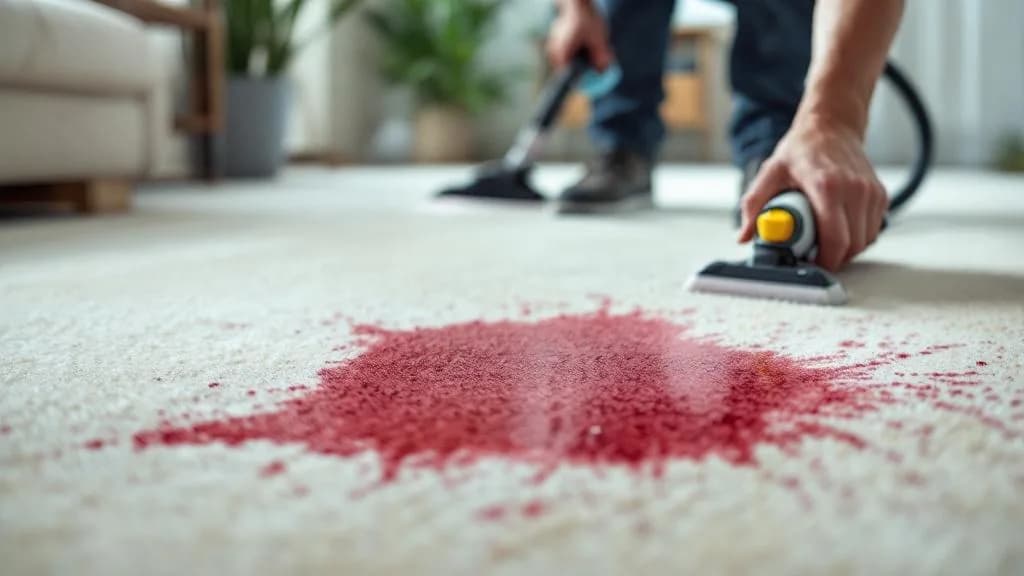
Fabric dye on carpet is a different problem from most stains. Coffee, wine, and mud are soiling agents. They sit in the fibre and can be extracted. Fabric dye is a colourant engineered to form a chemical bond with textile fibres. That is its entire purpose. The challenge for stain removal is that you are not cleaning a contaminant. You are trying to break or lighten a bond that was designed to be permanent.
Not all fabric dye behaves the same way
The category "fabric dye" covers a wide range of chemistry with different fixation mechanisms. What is possible for removal depends largely on the dye type and your carpet fibre.
| Dye type | Common source | Removal outlook on synthetic carpet | Removal outlook on wool/natural fibre |
|---|---|---|---|
| Fibre-reactive dye (Dylon, Rit liquid) | Home tie-dye, deliberate dyeing projects | Partial: some lightening possible if fresh | Very difficult: bonds directly to protein fibres |
| Direct dye (fabric paint thinned with water) | Fabric paint spills, craft projects | Moderate: can often be lifted significantly if treated quickly | Moderate: same window but more colour retention |
| Acid dye (wool/silk specific) | Professional textile work, silk dye kits | Low-moderate: not designed for synthetic, may not fully bond | Permanent: designed for protein fibre |
| Disperse dye (polyester-specific) | Industrial/crafting supply | Can be significant: requires heat to fix, cold treatment helps | Minimal risk: does not bond to natural fibre |
| Indigo/natural dye | Denim bleed, craft projects | Moderate if treated fast, otherwise progressive lightening | Difficult: porous natural fibre absorbs readily |
Time is the critical factor
Fabric dye continues to bond while it is wet and warm. A dye that spills and is treated within five minutes is a different problem from one that has been sitting for an hour. Speed of response is more important with dye than with almost any other stain category.
Do not rub
Rubbing spreads the dye laterally through the pile and drives it deeper into the backing. Blot only: work from the edge toward the centre to contain the spread.
What to do with a fresh fabric dye spill
- Blot up as much liquid as possible immediately. Use a clean white cloth or paper towel, pressing firmly, do not rub
- Apply cold water sparingly to dilute the dye concentration. Blot again to absorb the diluted dye, repeat 3–4 times
- Mix a small amount of dish soap with cold water and apply to the stain, blotting gently. This surfactant action can help lift loosely bonded dye molecules
- If the stain persists, apply a small amount of white vinegar (for acid-pH dyes) or a diluted hydrogen peroxide solution (3% only, test on a hidden area first): peroxide acts as a mild oxidising bleach and can lighten some dye types
- Rinse thoroughly with cold water and blot dry: heat from hot water or steam can set dye further
- Do not use heat (hair dryer, steam) until you are satisfied with the result
Hydrogen peroxide patch test
Always test 3% hydrogen peroxide on an inconspicuous area of your carpet before applying to the stain. Peroxide can lighten or bleach carpet pile, particularly on darker-coloured or wool carpet. A small test area left for 10 minutes shows the risk before you commit to the full stain.
Set dye: what is realistic
If fabric dye has been on the carpet for more than a few hours (especially if it has dried) home methods are unlikely to remove it fully. The chemistry has had time to bond. At this stage, the realistic outcomes are: significant lightening (partial removal), leaving a faded version of the stain; or professional treatment with specialist oxidising chemistry or reducing agents that may improve the result further.
Some dye stains that cannot be removed to "invisible" can be masked. Carpet dyeing services can colour-match and re-tint the affected area of pile, disguising the stain rather than removing it. This is a specialist service and not universally available, but it is an option for valuable or large-area carpet where replacement would otherwise be the only path.
What a professional can do
Professional carpet cleaners have access to stronger oxidising agents and reducing agents than consumer products. Oxidising agents (peroxide-based) break down coloured molecules by adding oxygen; reducing agents (sodium hydrosulphite) strip colour by removing oxygen. Both require careful chemistry and are not suitable for all carpet types. A professional will assess the carpet fibre, the dye type if known, and the age of the stain before recommending an approach, and will be honest when the damage is irreversible.
Find a local cleaner in the Sutherland Shire
In the Sutherland Shire? We know your time matters. Leave your enquiry with us and we'll make it our priority to get you a quote from a local cleaner.
Find a Matched Local SpecialistThis site matches enquiries with independent local carpet cleaners. We do not employ cleaners directly.
Get a Shire quote
In the Sutherland Shire? We help you get a quote from a local cleaner. They quote you directly.
Frequently asked
Can fabric dye be completely removed from carpet?
It depends on the dye type, how quickly it was treated, and your carpet fibre. Some dye types (particularly disperse dyes on synthetic carpet treated immediately) can be removed significantly or fully. Others, especially acid dyes on wool carpet or any dye left to set for hours, are likely permanent to some degree. Partial lightening is a more realistic outcome than full removal in most cases.
Will bleach remove fabric dye from carpet?
Household bleach (sodium hypochlorite) will lighten or remove the dye, but it will also strip colour from the carpet itself: leaving a bleach-white patch that is usually more visible than the original stain. Bleach is not recommended. A 3% hydrogen peroxide solution is a gentler oxidising approach that carries less risk of total colour loss, but still requires a patch test before use.
I spilled Dylon dye on carpet: what should I do immediately?
Blot immediately with a clean white cloth. Do not rub. Apply cold water to dilute, blot again. Repeat several times, then try a small amount of dish soap diluted in cold water. Dylon is a fibre-reactive dye, which bonds quickly: speed matters more than any specific product. If the stain persists after initial blotting, a diluted 3% hydrogen peroxide solution (patch tested first) is the next option.
Does hot water help with fabric dye stains?
No, hot water and heat generally set dye further. Use cold water only when treating fabric dye on carpet. Avoid using a steam cleaner or hot extraction on a fresh dye stain: the heat accelerates the bonding process.
Is carpet dyeing a realistic repair option for a large dye stain?
Yes, carpet dyeing (colour restoration) is a specialist service where a technician colour-matches the dye and re-tints the affected pile area. It works best on large areas where the original colour is known. Results vary with pile type and the original dye chemistry, but it is a legitimate alternative to full carpet replacement for significant staining.