
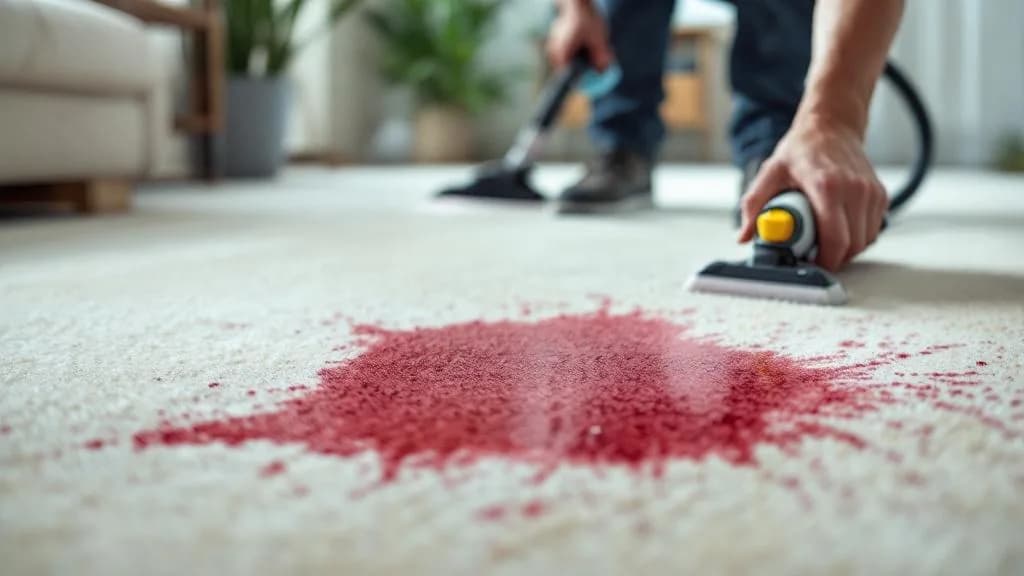
Self-tanning products (gradual tan moisturisers, mousse self-tanners, spray tans) contain dihydroxyacetone (DHA), the active compound that reacts with the amino acids in skin to produce the tan colour. When these products contact carpet, the same reaction can occur with the protein content in natural carpet fibres (wool, silk) and, to a lesser extent, can also leave a residual dye staining on synthetic fibres. The resulting stain is orange-brown and can darken over 12–24 hours as the DHA reaction completes.
Act Before the Reaction Completes
Fresh self-tanner on carpet should be treated immediately, before the DHA reaction has time to set. DHA-induced colour develops progressively, so a stain that looks pale immediately after the spill can become significantly darker after 12 hours if left untreated. For a fresh spill:
- Blot up excess product immediately. Do not rub.
- Apply cold water and blot to dilute the DHA concentration in the carpet fibres.
- Apply a small amount of washing-up liquid to the spot, work gently from the outside of the stain inward, and blot.
- Rinse with cold water and blot.
- If the carpet is wool: proceed with caution and do not use hot water or acidic treatments, which can damage wool fibres.
Dried or Set Self-Tanner Stains
Once the DHA reaction has completed and the stain has set, it is more difficult to remove than a fresh spill. The following sequence is the most effective approach for set self-tanner stains on synthetic carpet:
- Apply a small amount of hydrogen peroxide (3%) to the stain on a white cloth and blot. Test in a hidden area first: hydrogen peroxide can bleach carpet dye in some fibres.
- Alternatively: apply a paste of oxygen-based cleaner (such as OxiClean) mixed with water, allow to dwell for 10–15 minutes, then blot and rinse.
- For stubborn residual colour: isopropyl alcohol on a cloth, blot and rinse.
- Do not use bleach: chlorine bleach will damage carpet fibres and may permanently discolour the area.
Wool and silk carpet: do not use hydrogen peroxide or OxiClean
Oxidising agents including hydrogen peroxide and oxygen bleach can damage wool and silk fibres and strip their natural colour. For self-tanner on wool or silk carpet, use mild dish soap and cold water only, and consider professional treatment for stubborn staining.
Gradual Tan Moisturiser: Low-DHA Stains
Gradual tan moisturisers have a much lower DHA concentration than dedicated self-tanners, and the staining from them tends to be lighter and more amenable to dish soap and cold water treatment. The same principle applies. Treat promptly for best results.
Find a local cleaner in the Sutherland Shire
In the Sutherland Shire? We know your time matters. Leave your enquiry with us and we'll make it our priority to get you a quote from a local cleaner.
Get a MatchThis site matches enquiries with independent local carpet cleaners. We do not employ cleaners directly.
Get a Shire quote
In the Sutherland Shire? We help you get a quote from a local cleaner. They quote you directly.
Frequently asked
The stain looked light immediately after it happened but is now much darker the next morning. Why?
DHA reacts progressively with amino acids in the substrate. The browning reaction continues for up to 12–24 hours after contact. This is why treating immediately (before the full colour has developed) gives the best result. A stain that has fully developed is considerably harder to remove than one treated within the first 30 minutes.
I tried dish soap and the stain is still clearly orange-brown on my light beige synthetic carpet. What next?
Try an oxygen-based cleaner paste (OxiClean mixed with water to a paste, 10–15 minute dwell, blot and rinse). If residual colouring remains after that, 3% hydrogen peroxide blotted onto the stain can help, but test in a hidden area first as it can affect carpet dye. If neither works, professional carpet cleaning with enzyme or oxidising pre-treatment is the next step.