
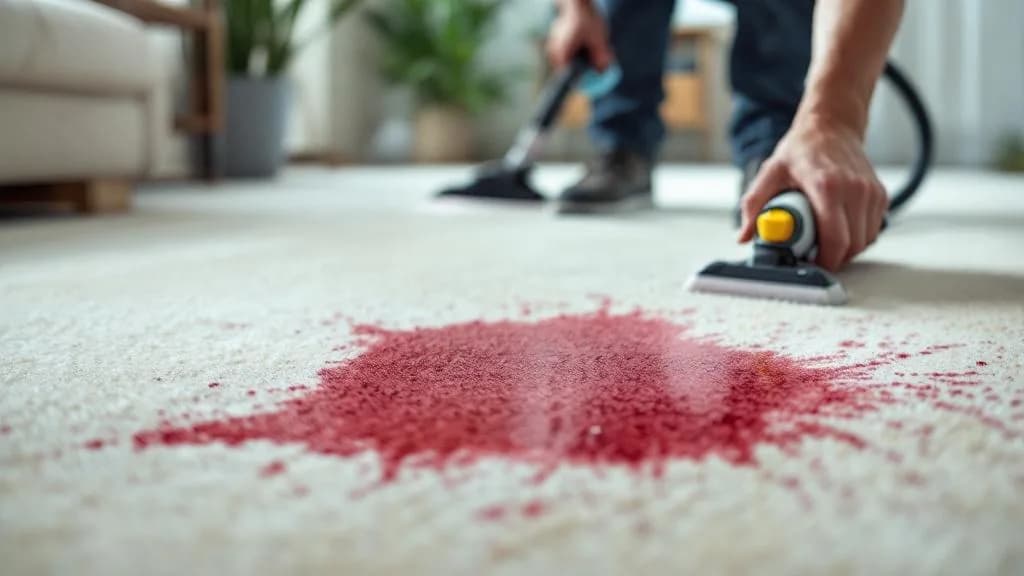
Hair toner is a colour-depositing product used after bleaching to neutralise yellow or orange tones in hair. It comes in purple, blue, ash, and silver formulations and works by depositing small amounts of complementary pigment into the hair shaft. This same pigment will deposit into carpet fibres on contact, and because toner is typically applied immediately after bleaching, the bathroom environment during a toning session is a high-risk time for carpet exposure.
Why toner stains set quickly
Hair toner contains direct dyes: dyes that bond to fibres without needing a fixative. These same direct dyes will adhere to carpet fibres, particularly protein-based fibres like wool and nylon, rapidly after contact. Purple and blue toners are especially tenacious because the violet pigment family has strong bonding characteristics. The faster you act, the better the outcome.
Immediate treatment (fresh toner spill)
- Blot immediately with white paper towels. Press firmly and lift. Do not rub. Change towels frequently as they pick up pigment.
- Apply cold water to the stain and continue blotting. Do not use hot water: heat opens carpet fibres and drives the dye deeper.
- Apply rubbing alcohol (isopropyl, 70%+) to a white cloth and dab the stain. Alcohol dissolves direct dyes and can lift significant pigment if the toner is still fresh.
- Blot, refresh with clean cloth sections, and repeat.
- Follow with an oxygen-based stain remover applied according to label directions. Allow full dwell time (often 5–10 minutes) before blotting.
- Rinse with cold water blotting and allow to dry.
Act within the first five minutes
Hair toner bonds to carpet fibres faster than most dyes. Treatment within the first few minutes of contact produces significantly better results than treatment after 15–30 minutes. If a spill occurs during a toning session, stop and treat it before continuing with hair processing.
Dried or set toner stains
Dried toner staining has bonded more firmly to the fibres. Rehydrate the area with cold water first, then proceed with the alcohol treatment above. Dried toner typically requires more treatment cycles and may only partially respond to home methods.
- After alcohol, try a commercial dye remover product (check compatibility with your carpet type: wool requires wool-safe products).
- On light-coloured synthetic carpets, a diluted hydrogen peroxide solution (one part 3% peroxide to four parts water) can be applied as a last home resort. Test in a hidden area first: peroxide can bleach some carpet dyes.
- Purple and blue toner stains that have set for several hours on synthetic or wool carpet are strong candidates for professional carpet treatment.
Protecting the carpet during future toning sessions
Place old towels or a plastic drop sheet on the bathroom floor during hair toning sessions. Toner drips and splashes during rinsing are the most common source of carpet exposure: covering the floor and being deliberate about containing the rinse water prevents the problem entirely.
Find a local cleaner in the Sutherland Shire
In the Sutherland Shire? We know your time matters. Leave your enquiry with us and we'll make it our priority to get you a quote from a local cleaner.
Find a Matched Local SpecialistThis site matches enquiries with independent local carpet cleaners. We do not employ cleaners directly.
Get a Shire quote
In the Sutherland Shire? We help you get a quote from a local cleaner. They quote you directly.
Frequently asked
I got purple toner on a cream carpet and it has turned purple. Can this be fixed?
Purple toner on cream carpet is one of the more visually striking stain scenarios. Fresh treatment with cold water and rubbing alcohol gives the best chance of significant improvement. Dried purple toner on cream carpet may require professional treatment with specialised dye-removing products. Complete removal cannot be promised for a stain that has been in contact for more than 30 minutes, but substantial improvement is usually achievable.
Can I use bleach on the toner stain to remove the colour?
No. Bleach will destroy the carpet dye along with the toner, leaving a larger, permanent bleach spot that is impossible to reverse. On light or cream carpet this may be less visible, but it is still an irreversible change to the carpet. Oxygen-based stain removers and peroxide (tested first) are the appropriate alternatives. They can lift the toner pigment without the carpet dye destruction risk of chlorine bleach.
The toner I used was "stain-free" according to the packaging. Why did it still stain my carpet?
Marketing claims of "stain-free" typically refer to clothing and skin: the dye deposits in hair and washes out of skin more easily than from porous or fibrous surfaces. Carpet fibres are a very different substrate. All toners containing direct dye can stain carpet; the "stain-free" description is not applicable to carpet contact.
My bathroom has tiles except for a small carpet strip. The toner dripped on that strip. Is the treatment different?
The treatment is the same. A carpet strip in a bathroom may be more exposed to humidity and moisture than a bedroom carpet, which can cause the toner to spread further into the pile before treatment. The same cold water and alcohol approach applies. Blot promptly, work from the edges in, and avoid rubbing.