
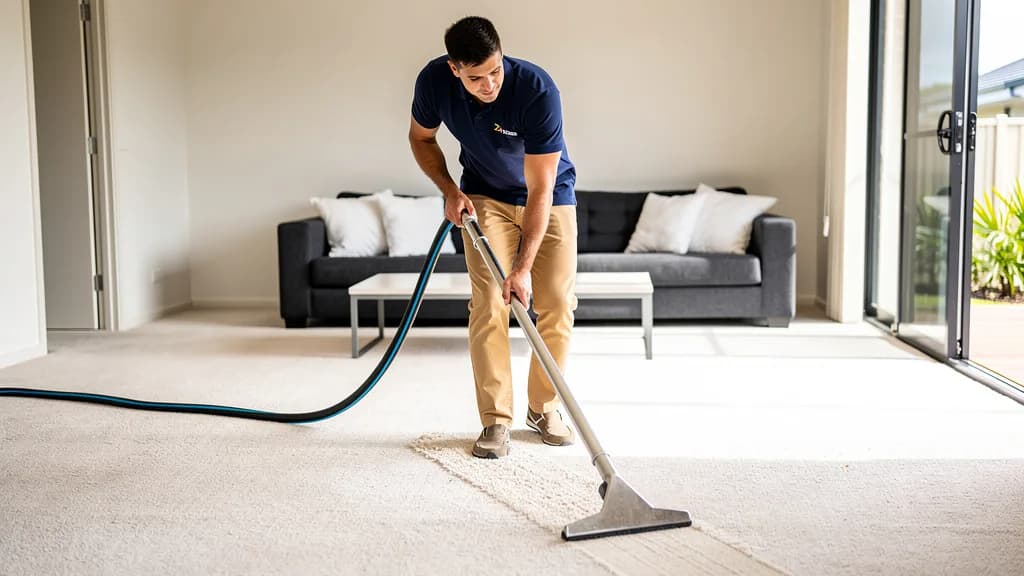
Hospitality carpet in Sutherland Shire restaurants and cafés (from the beachside venues at Cronulla to the casual dining strips in Miranda) faces a significantly more demanding cleaning challenge than any residential or standard office environment. The combination of food fat, beverage pigments, high foot traffic, and the time pressure of daily trading requires a systematic approach.
The Hospitality Soiling Profile
Restaurant and café carpet accumulates a distinct mix of contaminants that interact with each other and become increasingly difficult to remove over time. Understanding the profile explains why hospitality carpet needs more frequent professional cleaning than general commercial carpet:
- Food fats and cooking oils (including aerosol grease from kitchen proximity). These penetrate carpet fibre and act as a binder for other soiling, trapping dry particles and making the carpet surface progressively stickier and darker.
- Beverage pigments: wine, coffee, juice, soft drinks, and beer each leave distinct residues. Wine contains anthocyanins (dye-like pigments); coffee contains tannins that polymerise over time; beer and juice leave sugar residues that attract bacteria and odour.
- Foot traffic tracked soil, in coastal Sutherland Shire venues, beach sand is a common abrasive contaminant that accelerates carpet fibre wear.
- Food particle accumulation: in carpet pile between tables, attracting insects and bacteria if not addressed regularly.
- Incidental organic contamination: vomit (occasional but requiring immediate professional-grade treatment), blood from kitchen cuts, and other biological materials.
Recommended Cleaning Frequency
Hospitality carpet requires significantly more frequent professional cleaning than office carpet. The practical minimum:
| Venue Type | Recommended Frequency | Notes |
|---|---|---|
| Café (seated dining, moderate traffic) | Every 4–6 weeks | Coffee and milk residues polymerise; regular cleaning prevents irreversible darkening |
| Restaurant (table service, full menu) | Every 3–4 weeks | Wine and food fat accumulation is primary driver; pre-holiday period cleans essential |
| Bar or pub with carpeted areas | Every 3–4 weeks | Beer sugar residue and high traffic; beer-soaked carpet is a significant odour source |
| Function venue or event space | After each major event plus monthly baseline | Event-driven timing: a wedding or large function requires a post-event clean |
| Café or restaurant entry and waiting area | Every 2–3 weeks | Higher traffic concentration; first impression zone |
After-Close Timing: The Hospitality Constraint
Unlike office carpet cleaning, hospitality venues cannot always clean overnight: many operate late into the evening and need to set up for the following day. The practical window is often around 11pm–6am: after close, cleaning, and setup for breakfast or morning trade. This is shorter than the 6–8 hours hot water extraction can typically take to dry, depending on ventilation and weather.
Encapsulation cleaning is frequently the practical method for hospitality venues precisely because of this constraint: a typical 30–60 minute dry time, depending on ventilation and weather, means a venue cleaned at 11:30pm can be set for 7am trade. The trade-off is that encapsulation does not remove grease as effectively as hot water extraction at high temperature. A common approach is encapsulation for regular maintenance cleans plus a hot water extraction deep clean during the venue's annual closure period (such as the Christmas–New Year break or a planned closure week).
Pre-service and annual closure cleans
Plan the annual hot water extraction deep clean for your venue's closure period, such as the Christmas–New Year break. This is when carpet can dry fully (typically 6–8 hours, depending on ventilation and weather) without business impact, and deep grease extraction can happen. Pair this with a carpet protector application to slow grease penetration throughout the following year.
Grease in Hospitality Carpet: The Core Challenge
Food fat contamination is the defining difference between hospitality and general commercial carpet. Fat molecules bond to synthetic carpet fibres and create a hydrophobic surface: once enough fat has accumulated, water-based cleaning products literally bead off the surface. This is why hospitality carpet that has not been professionally cleaned for several months can appear 'unwashable' with standard products.
The professional solution is alkaline pre-spray at the appropriate concentration for the fat load, followed by hot water extraction. Commercial-grade alkaline pre-sprays are significantly more effective than consumer products. They emulsify the fat, allowing the extraction step to flush it out. The appropriate product concentration depends on the grease load, which is why hospitality cleaning is a distinct specialisation from residential or general commercial carpet cleaning.
Food Safety and Hygiene Considerations
NSW Food Authority requirements apply to food handling areas, not typically to carpeted dining areas: carpet is generally not permitted in food preparation or service areas under the Food Standards Code. However, carpeted dining areas in a food business are still part of the premises and must be maintained in a way that does not create food safety risks (attracting pests, harbouring bacteria that cross-contaminate food).
When selecting a carpet cleaning provider, confirm that the products used have documented Safety Data Sheets (SDS) and are safe for use in a food premises context: some industrial cleaning chemicals are not appropriate near food preparation and service areas. Residue-free chemistry (products that do not leave a sticky or solvent residue when dry) is particularly important for hospitality carpet near dining areas.
Carpet vs Hard Floor: The Hospitality Decision
Some hospitality venues choose hard floor surfaces for the maintenance advantage. For operators making this decision, the relevant considerations:
- Acoustic comfort: carpet significantly reduces noise in a dining environment: hard floors create echo, which increases ambient noise levels and reduces patron comfort at tables. The acoustic benefit is measurable and valued by diners, particularly in the quieter, fine-dining end of the market.
- Slip risk: in hospitality environments with spills, hard floors introduce a significant slip risk for both staff and patrons. Well-maintained carpet has better slip resistance than most hard floors when wet.
- Maintenance cost: carpet cleaned every 3–4 weeks professionally versus hard floor mopped nightly: the frequency difference is significant, but the professional cleaning cost per visit for carpet is typically higher.
- Replacement cost: high-traffic hospitality carpet typically needs replacement every 3–5 years; hard floor is more durable but the initial installation cost is higher.
- First impression: for premium dining venues, the visual quality of the carpet (or its absence) signals the dining category to patrons.
Find a local cleaner in the Sutherland Shire
In the Sutherland Shire? We know your time matters. Leave your enquiry with us and we'll make it our priority to get you a quote from a local cleaner.
Find a Matched Local SpecialistThis site matches enquiries with independent local carpet cleaners. We do not employ cleaners directly.
Get a Shire quote
In the Sutherland Shire? We help you get a quote from a local cleaner. They quote you directly.
Frequently asked
How often should restaurant carpet be professionally cleaned?
Every 3–4 weeks for a full-service restaurant with table service and a full menu. Cafés with moderate traffic: every 4–6 weeks. Bars with carpeted areas: every 3–4 weeks. Entry and waiting areas in any hospitality venue: every 2–3 weeks. These intervals are significantly shorter than general commercial office carpet (quarterly) due to the fat, beverage pigment, and foot traffic load.
Can restaurant carpet be cleaned overnight without disrupting the next morning's trade?
Yes, using encapsulation cleaning. It typically dries in 30–60 minutes, rather than the 6–8 hours hot water extraction can take, depending on ventilation and weather. A common approach is encapsulation for regular maintenance cleans, with hot water extraction deep cleans planned for the annual closure period when full drying time is available.
Why does our carpet look dark and stiff even after cleaning?
Dark, stiff-feeling carpet in a hospitality venue is typically caused by accumulated food fat that has bonded to the fibre. Once enough fat has accumulated, it creates a hydrophobic surface that standard cleaning products cannot effectively penetrate. This requires a commercial-grade alkaline pre-spray at the appropriate concentration for the grease load, followed by hot water extraction: a specialist hospitality cleaning service rather than a general residential cleaner.
What cleaning products are safe to use in a restaurant or food premises?
Products used in carpet cleaning near food service areas should have documented Safety Data Sheets (SDS), should be residue-free when dry (no sticky or solvent residue remaining), and should not include volatile compounds that off-gas into the food area. Ask your provider for the SDS for all products they use and confirm they are appropriate for use in licensed food premises in NSW.
Should we keep carpet or switch to hard floor in our restaurant?
Carpet provides measurable acoustic benefits (reduced ambient noise, better patron experience) and better slip resistance with wet spills than most hard floors. The maintenance burden is higher: professional cleaning every 3–4 weeks versus nightly mopping. For premium or quieter dining venues where acoustic comfort is valued, carpet remains the preferred choice. For high-turnover, casual or takeaway-adjacent venues where maintenance simplicity matters more, hard floor is often the practical choice.