
Window and glass cleaning products use a combination of isopropyl alcohol (typically 10–30%) as the primary solvent, ammonia (1–5%) as an alkaline cleaning agent, surfactants to reduce water spots, and often a blue or purple dye for product identification and streak visibility. The alcohol evaporates quickly; the ammonia raises the pH of the treated area; the surfactant leaves a residue; and the blue dye (often Brilliant Blue FCF or a similar synthetic dye) may stain carpet if the product is not removed promptly.
What each ingredient does to carpet
- Isopropyl alcohol: evaporates within minutes; low risk of permanent dye damage at these concentrations, though prolonged contact can affect some surface-dyed carpet
- Ammonia: raises local carpet pH; can affect acid-based dyes in wool carpet (the same mechanism as engine degreaser, but at much lower concentration); low risk on solution-dyed synthetics
- Surfactant: leaves a mild residue that attracts re-soiling if not rinsed out thoroughly
- Blue/purple dye: the biggest surprise: synthetic dye in concentrated window cleaner can stain carpet pile, particularly on light-coloured carpet; this is rarely permanent if treated promptly but can be stubborn
The blue dye in window cleaner can tint carpet if not treated promptly
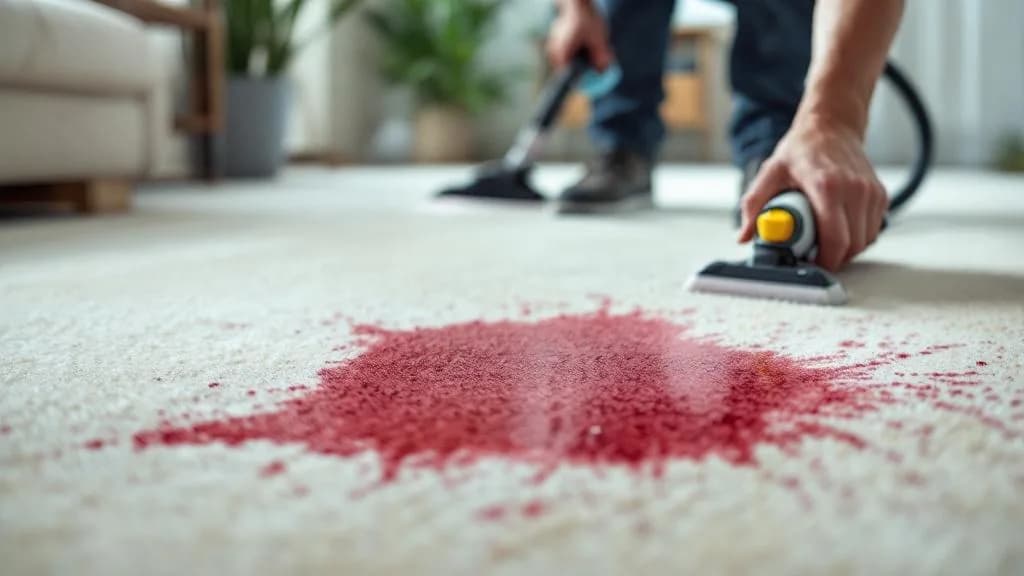
Most people do not realise window cleaner contains a colouring agent. On white or cream carpet, a significant window cleaner spill can leave a visible blue tint from the product dye. This is usually removable if treated immediately with cold water. It becomes more difficult after 15–30 minutes as the dye partially bonds to the fibre.
Removal method
- Blot up as much liquid as possible immediately
- Apply cold water and blot: dilutes the dye and begins removing the alcohol and ammonia components; the alcohol will already be partly evaporated
- Apply dish soap diluted in cold water and blot: addresses the surfactant residue
- Rinse thoroughly with cold water, at least four to five passes; the ammonia residue must be fully rinsed to avoid ongoing pH effects on wool or dyed carpet
- Check for any blue tint remaining. If visible, apply 3% hydrogen peroxide to a cloth and blot (test on hidden area first); this oxidises the synthetic dye
- Rinse with cold water and blot dry
- Monitor over 24 hours for re-soiling (indicates surfactant residue). If the area darkens again, repeat the rinse cycle
Ammonia risk on wool carpet
The ammonia in window cleaning products (typically pH 10–11 in concentrate) poses a real risk to wool carpet dye stability. Wool uses acid-based dyes that require an acidic environment for colour stability: ammonia shifts the local pH alkaline and can partially strip or alter these dyes, particularly on older or less colour-fast wool. If you spill window cleaner on wool carpet, rinse immediately and generously with cold water to dilute the ammonia concentration, then check for any colour change once dry. If colour change has occurred, contact a carpet colour restoration specialist.
Find a local cleaner in the Sutherland Shire
In the Sutherland Shire? We know your time matters. Leave your enquiry with us and we'll make it our priority to get you a quote from a local cleaner.
Find a Matched Local SpecialistThis site matches enquiries with independent local carpet cleaners. We do not employ cleaners directly.
Get a Shire quote
In the Sutherland Shire? We help you get a quote from a local cleaner. They quote you directly.
Frequently asked
Can I use window cleaner to clean carpet stains?
Window cleaner is sometimes suggested for carpet stains because its alcohol and ammonia content dissolves some organic compounds. However, the risks (ammonia affecting wool dyes, blue dye staining light carpet, and surfactant re-soiling) make it a poor choice compared to purpose-formulated carpet cleaners or the dish-soap-and-water approach. Avoid using window cleaner as a carpet cleaning product.
My carpet has a faint blue tint where the window cleaner was: will it come out?
If treated within an hour or two, yes: the synthetic blue dye in most window cleaners responds to cold water dilution and hydrogen peroxide. Apply 3% hydrogen peroxide to a cloth, blot onto the blue area, leave for 5 minutes, rinse with cold water. If the blue tint has been there for more than a day, it may have partially bonded to the fibre; professional pre-treatment with a reducing agent (sodium thiosulfate) can address persistent synthetic dye stains on carpet.
Does the ammonia in window cleaner damage carpet permanently?
On solution-dyed synthetic carpet (the most common modern carpet type), ammonia at window-cleaner concentrations rarely causes permanent damage: the dye is embedded throughout the fibre and is less pH-sensitive. On wool or older surface-dyed carpet, ammonia can cause colour change that is irreversible. If in doubt, rinse aggressively with cold water immediately and check for colour change once dry.
I accidentally sprayed window cleaner on the carpet while cleaning a glass coffee table: is a small amount a problem?
A brief overspray of a small amount of window cleaner on carpet is unlikely to cause a visible problem: the alcohol evaporates, the ammonia concentration is low, and the dye is dilute. Blot the area with a damp cloth to dilute the residue and allow to dry. The main risk is on white carpet where even dilute blue dye can be slightly visible. For dark or mid-tone carpet, a brief overspray typically causes no lasting mark.