
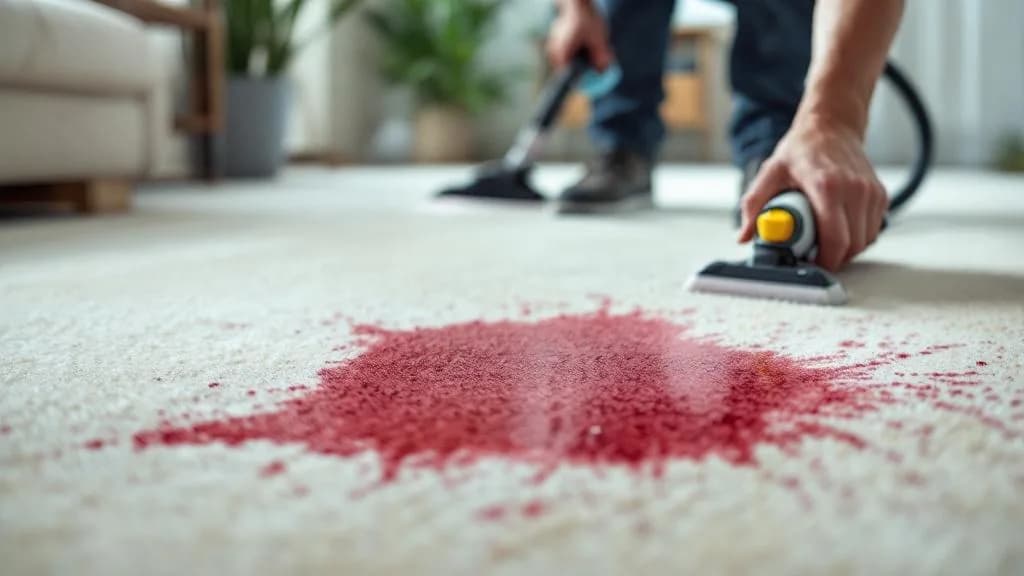
Wood stain and deck oil share two characteristics that make them particularly difficult carpet stains: a penetrating oil or solvent carrier that drives colour deep into fibre structure, and a pigment load designed to bond to porous surfaces. The formulation type (oil-based, water-based, or solvent-based) determines which removal approach has any chance of working.
Step 1: Identify the Formulation
Check the product can or data sheet before treating. This determines your entire removal strategy.
| Product Type | Common Brands/Types | Removal Approach |
|---|---|---|
| Water-based wood stain | Cabot's Aquadeck, Feast Watson Water-Based | Dishwashing liquid + cold water while wet; professional treatment when dry |
| Oil-based wood stain | Traditional oil stains, teak oil, tung oil | Mineral turpentine for wet spills; professional solvent extraction when dry |
| Deck oil (penetrating oil) | Cutek, Intergrain UltraDeck Oil | Blot oil carrier first, then mineral turpentine; professional treatment recommended |
| Solvent-based stain/varnish | Polyurethane stains, solvent-based finishes | Mineral turpentine with caution; high solvent load can damage carpet backing |
Step 2: Immediate Wet Spill Treatment
- Blot up as much liquid as possible immediately with clean white cloths or paper towels. Press firmly: do not rub. Work from the outside of the spill inward.
- For water-based stains: apply a dishwashing liquid and cold water solution and blot repeatedly. Rinse with cold water between passes.
- For oil-based stains and deck oils: apply a small amount of mineral turpentine to a clean white cloth and blot the stain. Do not pour directly onto the carpet. Work in a ventilated area.
- Continue blotting with fresh cloth sections until the colour stops transferring.
Ventilation is essential for solvent use
Mineral turpentine and solvent-based products release fumes that accumulate in enclosed spaces. Open windows and doors before applying any solvent to carpet. Do not use near open flames or heating elements.
Dried Wood Stain: Realistic Expectations
A wood stain or deck oil that has dried and cured is one of the hardest carpet stains to treat. The pigment has chemically bonded to fibre surfaces in the same way it bonds to timber, which is exactly what it is designed to do. DIY attempts on dried stains frequently spread the stain boundary or introduce solvent damage to the carpet backing without removing significant colour. For dried spills, professional assessment is the most sensible first step.
Always Test Solvents First
Mineral turpentine can affect some carpet dyes, particularly on wool or older synthetic carpet. Before applying to the stain, test on a small hidden area: inside a wardrobe or behind furniture. Apply a small amount, wait 2 minutes, then blot and check for colour change on the cloth. If the carpet colour bleeds, do not proceed with solvent treatment and contact a professional.
When Professional Treatment Is the Right Call
For all but the smallest fresh water-based spills, professional hot-water extraction with specialist pre-treatment compounds gives substantially better results than DIY approaches. Professionals have access to stronger solvent formulations, controlled application equipment, and extraction capability that removes both the stain and the solvent carrier from the carpet. A matched local specialist can advise whether the stain is treatable or whether patching is a more realistic option.
Find a local cleaner in the Sutherland Shire
In the Sutherland Shire? We know your time matters. Leave your enquiry with us and we'll make it our priority to get you a quote from a local cleaner.
Find a Matched Local SpecialistThis site matches enquiries with independent local carpet cleaners. We do not employ cleaners directly.
Get a Shire quote
In the Sutherland Shire? We help you get a quote from a local cleaner. They quote you directly.
Frequently asked
Can acetone remove wood stain from carpet?
Acetone dissolves some stain components but is aggressive on carpet fibres and backing, particularly on polypropylene and certain glued-down carpets where it can dissolve the backing adhesive. It also spreads the stain rapidly if applied without precision. Mineral turpentine is a safer first solvent choice for most carpet types; reserve acetone for a last resort on small areas, and always test first.
I spilled deck oil: the stain is large. What do I do?
For a large deck oil spill, absorb as much as possible immediately using cat litter, cornstarch, or baking soda poured over the area. These absorb the oil carrier before it penetrates deeply. Leave for 15 minutes, then vacuum up the absorbent material. Follow with mineral turpentine blotting on the remaining stain. For large spills, professional treatment is strongly recommended, as the oil volume typically exceeds what DIY methods can handle.
The stain is on a wool carpet: can I use turpentine?
Mineral turpentine can be used on wool carpet but with extra caution: wool fibres are more sensitive to solvent damage than most synthetics. Use sparingly, test on a hidden area first, and keep dwell time very short (30 seconds maximum before blotting). If the test area shows any change in texture or colour, stop and contact a professional cleaner with wool carpet experience.