
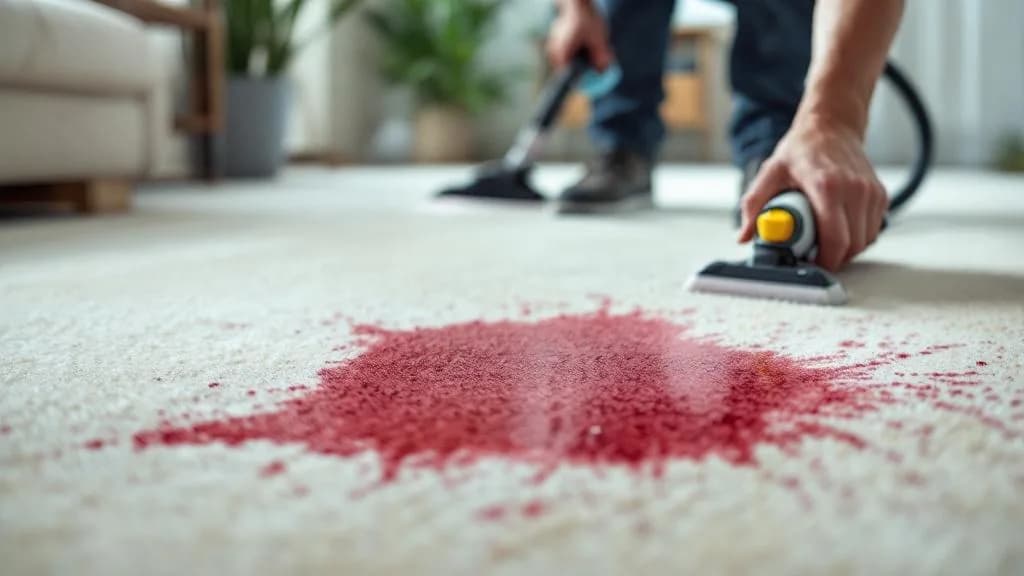
Fabric softener (liquid conditioner) works by depositing a thin layer of cationic surfactant, typically a quaternary ammonium compound (quats), onto textile fibres. This coating reduces static, gives fabric a soft feel, and adds a fragrance. On carpet, the same mechanism applies: the quat compound bonds to the fibre surface and stays there. The residue is not visually obvious initially but is slightly oily and sticky. It continuously attracts dust, foot-traffic grime, and soil particles, creating a progressively darkening area that looks like a new stain each time it is cleaned.
The re-soiling mechanism
The re-soiling problem with fabric softener on carpet is identical to the one caused by insufficient rinsing of detergents and degreasers: residual surfactant on the fibre attracts particulate matter from footwear, air, and furniture. The affected area appears clean immediately after treatment but darkens again within days to weeks as the sticky coating accumulates new soil. The only solution is to remove the residue completely, which requires more rinse volume than most people apply.
Removal method
- Blot up as much liquid softener as possible immediately with a dry cloth
- Apply warm water (not hot) to the area and blot: warm water is more effective than cold at dissolving the quat compound from fibre
- Apply a small amount of dish soap diluted in warm water and blot: helps lift the surfactant coating
- Rinse with warm water. This is the most critical step; apply and blot at least six to eight times with fresh water each pass
- The area should produce no foam on the blotting cloth before rinsing is considered complete; foam indicates residual surfactant
- Blot dry; monitor over 24–48 hours. If the area darkens again as it dries or after foot traffic, the surfactant was not fully removed; repeat the warm-water rinse cycle
Rinse until there is no foam. This is the only reliable indicator
Unlike most stains where you can see when the colour is gone, fabric softener residue is largely invisible. The only reliable indicator that it has been fully removed is that the rinse water produces no foam when you blot. Foam means surfactant is still present in the pile. Keep rinsing.
Large spill or multiple applications
Some homeowners accidentally use fabric softener instead of carpet cleaning solution, or apply it in an attempt to soften stiff carpet fibres. This results in a large-area softener residue that causes widespread re-soiling. A single targeted rinse is rarely sufficient: the area needs to be wet-extracted (using a carpet cleaning machine or a wet/dry vacuum) multiple times with clean water. Professional hot-water extraction is the most effective way to clear a large-area fabric softener application from carpet.
Find a local cleaner in the Sutherland Shire
In the Sutherland Shire? We know your time matters. Leave your enquiry with us and we'll make it our priority to get you a quote from a local cleaner.
Find a Matched Local SpecialistThis site matches enquiries with independent local carpet cleaners. We do not employ cleaners directly.
Get a Shire quote
In the Sutherland Shire? We help you get a quote from a local cleaner. They quote you directly.
Frequently asked
Can I use fabric softener to make carpet soft or fresh-smelling?
This is sometimes suggested as a home hack but it creates the re-soiling problem described above. The quat coating that makes fabric feel soft will cause carpet to accumulate soil visibly within days. Carpet fibres are designed to be cleaned with neutral pH extractants and rinsed thoroughly: fabric softener is an additive that remains on the fibre by design. Do not apply fabric softener to carpet.
I spilled softener and the carpet keeps going dark in that spot even after cleaning: what am I doing wrong?
The softener residue has not been fully removed. Each time you clean the dark spot, you may be adding more water and detergent on top of the residue rather than removing it. The solution is more clean warm water: more rinse passes with plain warm water than you think are necessary. The area must reach a state where blotting with a cloth produces no foam at all before re-soiling will stop.
Is fabric conditioner the same as fabric softener?
Yes, fabric conditioner and fabric softener are the same product under different names. Both deposit a cationic quaternary ammonium surfactant onto textile fibres. The carpet treatment is identical regardless of which name appears on the label.
Does professional carpet cleaning remove fabric softener residue?
Yes, professional hot-water extraction is the most effective method for large-area softener residue because it flushes water through the pile at pressure, physically removing the surfactant from deep in the fibre. One extraction pass may not be sufficient; the operator may need to run a second pass with plain hot water to complete the rinse. Mention the softener spill explicitly so the operator knows to do a thorough rinse pass.